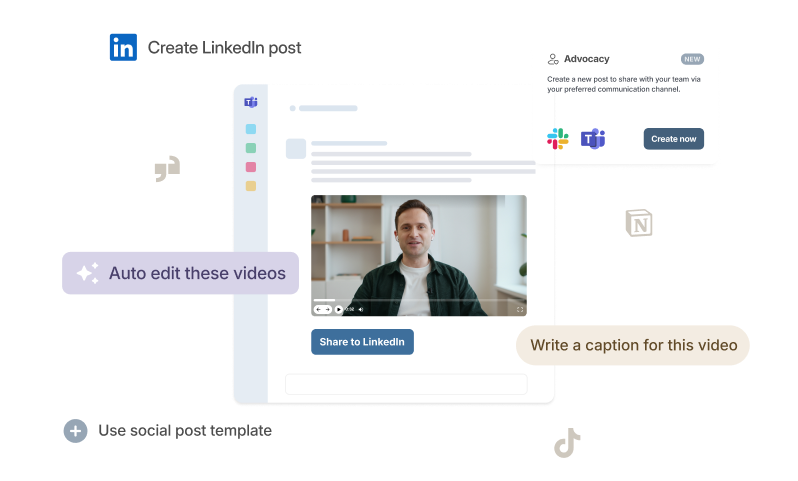
Employee advocacy programs aren’t failing because employees are unwilling to participate. They fail because the content queue runs dry. The first few weeks go well, then the cadence slips, then participation drops, and within three months the program is effectively inactive.
The supply problem is the most common and least discussed challenge in employee advocacy. Building a program is one thing. Keeping it updated with content that employees actually want to share, that resonates with their specific networks and that does not require a production team is an entirely different challenge.
This guide is about best practice in employee advocacy content : what content performs best, how to brief employees so they produce something credible rather than something scripted, how to build a content calendar that sustains momentum and how to solve the supply problem for good.
Bring your employer brand to life
- Empower employees’ storytelling
- Transform careers sites with video
- AI-driven video editing
- Publish videos anywhere
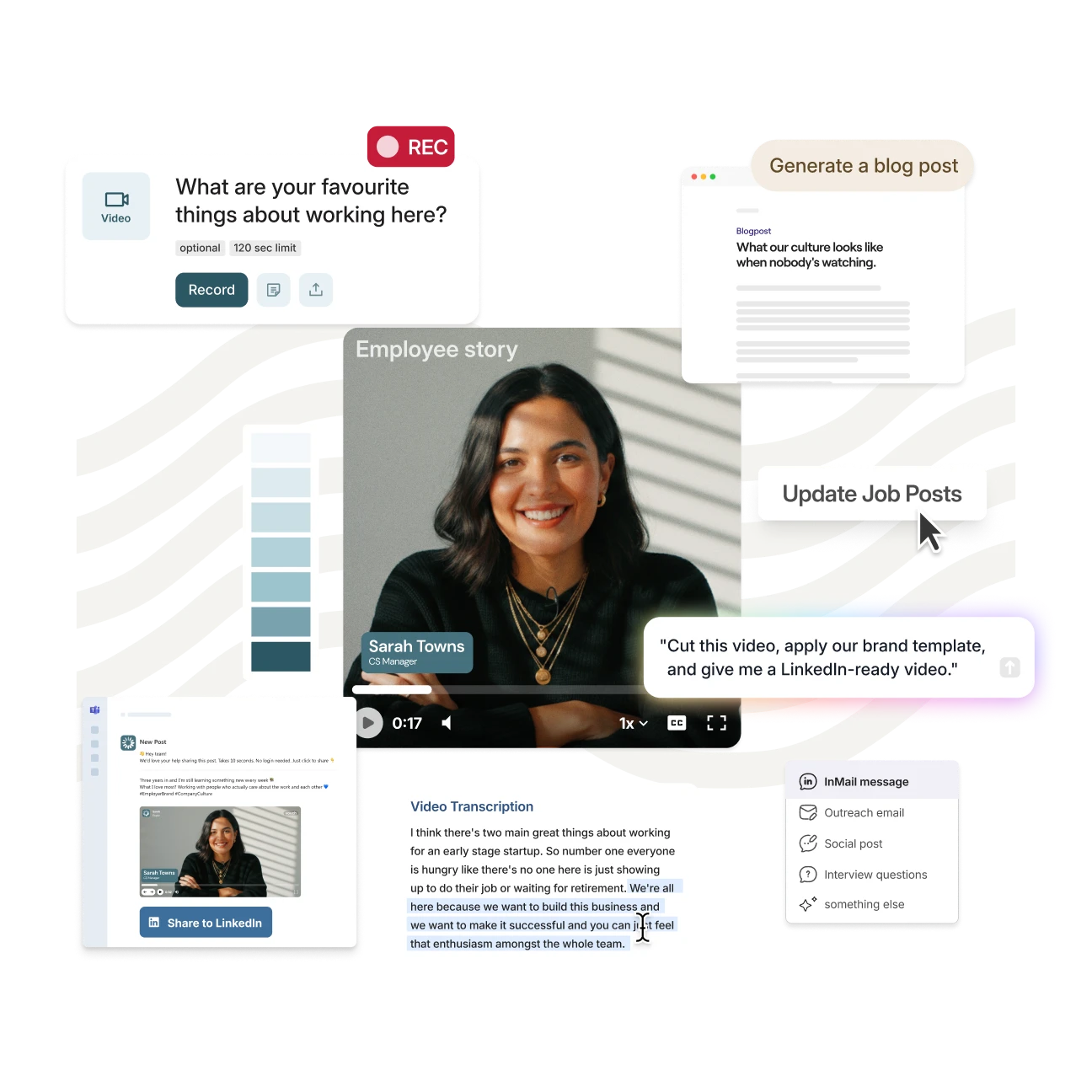
Why content quality is the real differentiator
Two advocacy programs can have identical platform setups, the same number of enrolled employees and the same delivery cadence. One generates meaningful reach and engagement. The other produces low share rates and posts that underperform when they do go out. The difference is almost always the content.
Content shared by employees achieves 561% more reach than the same content from a company page, but that multiplier only applies when the content is worth sharing. Generic brand announcements pushed through employee profiles perform no better than generic brand announcements from the company page. What generates the lift is content that feels personal, specific, and honest. Content that only an employee could credibly share.
83% of employees feel more engaged when their company encourages advocacy. That engagement is highest when what they are asked to share reflects their actual experience, not a marketing message with their name on it.
The content types that perform best
Not all advocacy content is equal. The formats below are the ones that consistently generate the strongest results across LinkedIn and other professional channels, in order of typical performance.
For specific question prompts for employee story video and testimonial content, see 5 Employee Testimonial Questions: Updated for 2026.
How to brief employees so the content actually works
Most advocacy content fails before it gets shared. The brief is too vague, the employee has no idea what to say, and what eventually gets posted reads like it came from the company page. The fix is simple: specific questions produce specific answers.
Give them a specific question, not an open topic
“What surprised you in your first three months?” produces better content than “Tell us about the culture.”
“What does your team do that you have not seen done as well anywhere else?” produces better content than “Describe your team.”
Open briefs produce company-speak. Employees default to the language they have heard in all-hands meetings and internal communications. A specific question bypasses that and gets them answering in their own voice.
Vouch’s structured question prompts are designed to do exactly this. A browser link, a specific question, their own time. What comes back is content no agency brief could replicate.
Remove the expectation of polish
The most common reason employees decline to participate in video advocacy content is that they think it needs to be polished or perfect. It does not. In fact, overproduced content consistently underperforms authentic self-recorded video in advocacy contexts, because audiences can tell the difference.
When briefing employees, be explicit: this does not need to look like a TV commercial. One minute. Your device. Your own words. The goal is genuine, not perfect.
Vouch handles the professional presentation automatically. AI helps trim the content, creates captions in multiple languages instantly, and applies branded overlays meaning the output looks professional even when the recording was done in two minutes on an iPhone.
Target the brief to the employee’s network
An engineering manager sharing content about the sales culture is not useful to anyone. A customer success manager sharing a role in Berlin is not useful to Sydney.
Match the brief to the employee’s role, team, location and the audience they are likely to reach. Vouch’s content targeting system handles this automatically: each employee only receives content tagged as relevant to their profile. But the brief itself should also be tailored, because employees share content more readily when they can see why it would resonate with their specific connections.
Give them the post copy
The single biggest friction point in advocacy participation is not the content itself. It is not knowing what to say in the post. Most employees are willing to share something. Most are not willing to write the caption from scratch.
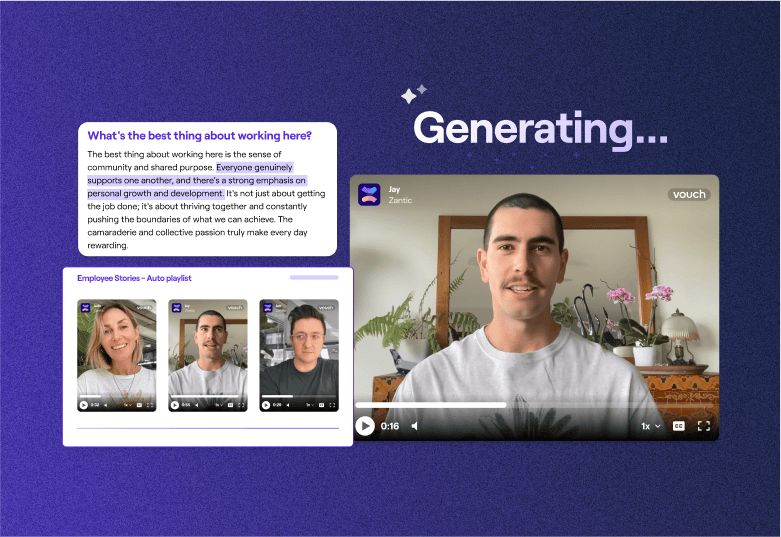
Vouch AI generates post copy in your brand voice that employees can edit before sharing. They go from a blank page to a draft they can personalize in seconds. That single change typically produces a significant increase in sharing rates within the first week.
Solving the supply problem
A consistent advocacy program needs a consistent flow of fresh content. That is harder than it sounds. Most teams underestimate how much content a program needs to sustain participation, and overestimate how much time they have to produce it.
In practice, a steady-state program needs fresh content delivered at least fortnightly, a mix of content types across different teams and roles and enough variety that each employee receives something relevant to their network rather than the same post as everyone else.
Think in libraries, not campaigns
The production mistake most teams make is treating each piece of content as a standalone project. Booking time, briefing employees, collecting content, editing and publishing, one piece at a time. That process cannot sustain the volume a program needs.
The shift is to think in libraries. A single async capture session with four or five employees, each answering five or six questions, can produce twenty to thirty usable clips covering multiple roles, teams and topics. Those clips do not all go out at once. They are tagged in Vouch by team, role and campaign and released over the following weeks, keeping the content feed fresh without requiring ongoing production.
Vouch’s async capture model is built for exactly this. Employees record in their own time via browser link, and Vouch AI processes each clip. A session that would have taken a full production day and a significant budget now takes a few hours of employee time and produces content for weeks.
Start with what you already have
Most organizations already have a wealth of employer brand content. The challenge isn't creating more. It's knowing where it is.
Some of it may already live in your Vouch library. Other assets are often scattered across shared drives, SharePoint folders, Dropbox, marketing DAMs, or buried in old campaign folders. Recruitment videos, employee stories, office tours, engineering talks, culture moments, blog posts and thought leadership all have the potential to become employee advocacy content.
Rather than starting every advocacy programme with a blank slate, begin by bringing your existing assets together into Vouch’s single, searchable library. Review what can be shared, pre-approve the content, add suggested copy where appropriate, and organize it with tags so employees can easily find relevant posts.
This creates an immediately usable advocacy library from day one. Any new video or content you produce simply expands the library over time, rather than replacing it.
Build a capture habit, not a production schedule
The teams with the most sustainable content programs treat capture as a habit rather than a project. A monthly prompt to a rotating group of employees. A quick Slack message after a product launch. A short video request to new joiners in their first week.
None of these require a shoot. They require a Vouch request link and a specific question. Over time, the library grows continuously rather than in sporadic production bursts.
Building your advocacy content calendar
An employee advocacy calendar doesn't need to be filled months in advance or contain brand-new content every day. The goal is simply to maintain a steady flow of relevant content for the right employees.
It needs to answer three questions: what content goes out, to which employees and when.
You don't need a month's worth of brand-new content before launching an advocacy program. Instead, think about maintaining a healthy mix of content that employees can share.
A typical advocacy program might include:
- Employee stories and day-in-the-life videos
- Open roles and hiring campaigns
- Leadership perspectives and company updates
- Customer stories and company milestones
- Behind-the-scenes moments and team celebrations
- Blog posts, podcasts and thought leadership
The goal isn't to publish every type of content every week. It's to ensure employees regularly have a variety of relevant content they feel confident sharing with their own networks.
Think about alternating content across formats (video, text, job listing, culture moment) to avoid repetition. Different teams are featured each week so that employees receive content relevant to their specific professional networks. Target the job listing shares to employees whose connections are likely to know someone relevant, do not broadcast them to everyone.
In Vouch, content can be tagged by role, department, location or campaign, so employees only receive content that's relevant to them. That's one of the biggest drivers of long-term participation. People rarely stop engaging because they're asked to share occasionally. They stop engaging when every post feels irrelevant to them.
What not to include in your advocacy program
Content that performs well in advocacy programs tends to be specific, human and role-relevant. The content types below consistently underperform, regardless of how well they are produced.
Generic brand announcements
Award wins, funding announcements, headcount milestones. These are not inherently bad content, but they are content the company should share from its own channels. Asking employees to amplify corporate announcements is not advocacy. It is asking employees to act as a distribution channel for the company’s marketing calendar, and most employees will not do it consistently.
Polished produced video
A highly produced employer brand video shared through an employee’s personal LinkedIn typically performs worse than a two-minute self-recorded clip from the same employee talking about the same topic. The production signals that the content was made by the company, not by the person sharing it. Authenticity is what makes employee-shared content credible, and authenticity does not come from a production team.
Content without a human angle
Product updates, company news, industry reports. These can work when shared by an employee who has a genuine perspective on the topic. They do not typically work when shared as generic reposts with no personal context. If the post could have been written by anyone at the company, it probably should not be in the advocacy program.
Sending too frequently
Sending employees more than two or three pieces of content per week is one of the fastest ways to reduce participation. Employees disengage not because they stop caring about the program but because the volume makes sharing feel like a task rather than a choice. Quality and relevance matter more than frequency.
Advocacy content that keeps a program alive
An advocacy program is only as strong as the content flowing through it. The programs that sustain participation over time are not the ones with the most employees enrolled or the most sophisticated platform setup. They are the ones producing a consistent stream of authentic, relevant content that employees actually want to put their name on.
That requires a production model that does not bottleneck on a video crew, a briefing process that gets specific answers rather than generic ones and a content calendar that targets the right content to the right people rather than broadcasting the same post to everyone.
Vouch is built for all of it. Employees capture authentic content in minutes via Vouch request link. AI supports the editing, captioning, and brand template overlays. Content is tagged, and distributed to the right employees via Slack or Teams with one-click to share to LinkedIn. And analytics show exactly which content is driving reach and engagement so you know what to make more of.
Teams at Mongo DB, NRMA, GoDaddy, Funlab, Culture Amp and Flight Centre use Vouch to keep their programs supplied with employee content that performs.
Start capturing employee content today
Vouch gives your team the tools to capture authentic employee content at scale, distribute it to the right people and measure what it produces, without a video crew or a separate tool for every step.
Book a 20-minute demo.
Frequently Asked Questions
How much content does an employee advocacy program actually need?
The key is not volume but relevance: employees share more readily when every piece of content feels appropriate for their specific network rather than a generic broadcast. A fortnightly or monthly capture session producing fifteen to twenty clips from different employees and teams gives you enough to maintain that cadence without constant production.
What is the best content format to start with?
Employee story video. It is the highest-trust format, the most reusable across channels and the one that tends to produce the strongest results in terms of engagement and application rate. It is also the format where Vouch has the most impact, because the traditional production barrier disappears when employees can record via a Vouch request link in their own time. Start with three to five employees answering one specific question each, and you instantly have a content library that covers your first month.
How do you get employees to record video content consistently?
Remove every barrier you can. A browser link to record on their own device is easier than an app download. A specific question is easier than an open brief. A one-minute time expectation is easier than an open-ended session. Vouch’s async capture model addresses all three. Also show employees the results: participation rates go up when employees can see that their post reached several thousand people or drove traffic to a job listing. Making the impact visible is one of the most reliable ways to sustain participation over time.
How do you keep advocacy content feeling authentic rather than corporate?
Authentic content comes from specific questions and specific answers. The moment the brief gets generic, the content gets generic. Ask employees what surprised them, what they would tell a friend, what their team does that they have not seen anywhere else. Avoid asking them to describe the culture or explain why the company is a great place to work: those questions produce the answers you want to hear rather than the answers their network will trust. If the content could have been written by a PR team, it will perform like it was.
How do you handle employees who produce content that does not match brand guidelines?
Vouch’s AI-generated post copy gives employees a draft in the brand voice that they can edit before posting, which handles most brand consistency issues without requiring manual review. For video content, Vouch applies brand overlays automatically. A clear, simple set of content guidelines shared with employees upfront, covering what is and is not appropriate to share, addresses the edge cases. The programs that over-engineer the approval process tend to kill participation. Employees disengage when sharing feels like a compliance exercise.
Should advocacy content be different for different roles or teams?
Yes, and this is one of the most impactful things you can get right. An engineering manager’s LinkedIn network is different from a sales manager’s network. Content about the engineering team’s culture is relevant to one and not the other. Vouch’s role-based targeting tags every piece of content by team, role, location and campaign so employees receive only what is relevant to their specific professional network. That targeting is what sustains participation over time. Mass broadcast, the same content going to everyone, is one of the main reasons advocacy programs lose momentum after the first month.

You might also like

Elevate Your Brand Today With Vouch
Discover how Vouch can accelerate talent acquisition while helping you stay on-brand.