Most companies have some version of an employer brand. Very few have a deliberate strategy behind it. The result tends to follow a predictable pattern: inconsistent messaging across channels, content that sounds like it was written by a committee, a hiring pipeline that relies too heavily on job boards and a leadership team that keeps asking why the employer brand investment is not showing up in hiring outcomes.
The companies consistently attracting and retaining great talent are not necessarily spending more or running larger teams. They have a clear, repeatable process that connects what makes them genuinely great to work for to the right candidates, through the right channels, with the right content, and then measures what happens as a result.
This guide gives you that process in eight steps, designed for Employer Brand Managers, Talent Acquisition Leaders and People and Culture Directors who need to build or overhaul their strategy in 2026. Each step includes real actions rather than broad principles.
By the end you will have a working framework from audit to activation to iteration, a redesigned channel and measurement table, and a reference template you can take straight into planning.
Bring your employer brand to life
- Empower employees’ storytelling
- Transform careers sites with video
- AI-driven video editing
- Publish videos anywhere
What is an Employer Branding Strategy?
An employer branding strategy is a deliberate, long-term plan for shaping how current and prospective employees perceive your company as a place to work. It covers how you identify what makes you genuinely distinctive as an employer, how you communicate that through content and channels, how you activate employees as advocates and how you measure whether any of it is working.
A few distinctions worth making:
- It is not a one-off campaign. A campaign has a start date and an end date. A strategy is continuous.
- It is not your consumer brand. Your employer brand targets potential and current employees. It may share visual identity and values with your consumer brand, but the audience, message and channels are different.
- It is not your EVP. Your Employee Value Proposition is the foundation the strategy is built on, not the strategy itself. The strategy is the full plan for how you develop, communicate and measure the EVP.
- It is not a job listings refresh. Job listings are one channel. A strategy spans every touchpoint a candidate or employee has with your organization.
Companies with a strong employer brand see up to 50% more qualified applicants, hire twice as fast and reduce cost per hire by up to 50% (Universum). That is the business case. The strategy is how you get there.
STEP 1 : Audit your current Employer Brand
Before building anything, you need to know where you stand. Most employer brand audits uncover a significant gap between how leadership believes the company is perceived as an employer and how current employees and candidates actually experience it. Closing that gap starts here.
A thorough audit covers four areas:
Internal audit
Talk to your people. Run a short pulse survey or a series of structured interviews asking employees what they would tell a friend about working there, what they would change and what they wish they had known before joining. Vouch's async video capture is a practical way to run these interviews at scale, with employees recording their responses via browser link in their own time, producing richer and more candid answers than a scheduled call and leaving you with a library of clips you can use directly as EVP proof points. Pull your most recent eNPS score and review exit interview data for recurring patterns. The goal is a clear picture of the actual employee experience, not the aspirational one.
Questions worth asking:
- Why did you join us, and does the reality match what attracted you?
- What is the one thing you would tell a friend who was considering joining?
- What is missing from how we talk about ourselves as an employer?
- If you were going to leave, what would be the main reason?
External audit
Review how you appear to candidates who are researching you before they apply. Check your Glassdoor and Indeed profiles: rating, review volume, sentiment themes and how leadership is responding to feedback. Review your LinkedIn company page: follower count, post engagement and what your employees are already sharing about you organically. Look at your careers page as a first-time visitor would.
Key signals to document:
- Glassdoor and Indeed overall rating and trend direction
- Most common themes in positive and negative reviews
- Careers page traffic and bounce rate (from Google Analytics)
- LinkedIn follower growth rate and top-performing employer brand posts
- Any notable press coverage, awards or employer brand rankings
Competitive audit
Pick two or three competitors or companies competing for the same talent. Review their careers pages, LinkedIn presence, Glassdoor profiles and any employer brand content they are producing. The goal is not to copy their approach but to identify the positioning gaps they are not owning that you could.
Content audit
Catalog what employer brand content already exists: videos, photography, social posts, job description copy, careers page copy and any EVP documentation. Assess whether it is consistent in tone, visual identity and message. Most organizations discover they have more content than they thought but little of it is being used effectively or distributed beyond the careers page.
Audit output: Create a simple SWOT of your current employer brand position. Strengths you can amplify, weaknesses to address, opportunities competitors are not owning and threats to your talent pipeline if nothing changes.
STEP 2: Define Your Employee Value Proposition
Your Employee Value Proposition is the foundation everything else is built on. It is the reason someone chooses to work for you over a competitor and the reason someone already there stays. Keep it vague and the rest of the strategy falls apart, because every piece of content, every channel decision and every campaign needs to be anchored to something specific and true.
What the EVP is and is not
Your EVP is not a tagline and not an aspiration. It is a clear, honest articulation of what your company offers employees, backed by specific proof points, that is meaningfully different from what your talent competitors are offering. A strong EVP has three qualities: it is true (employees would recognize and agree with it), it is distinctive (it does not sound like every other employer in your space) and it is relevant (it speaks to what your target candidates actually care about).
How to develop your EVP
The EVP must be grounded in research, not written in a workshop by people who do not do the day-to-day work. The primary inputs are employee interviews and focus groups, pulse survey data and exit interview themes. You are looking for the genuine reasons people join, stay and leave.
A practical process:
- Run 8 to 12 employee interviews across different roles, tenure levels and locations
- Ask each person: what do you tell friends about working here, what would make you leave and what surprised you positively after joining?
- Group the themes into 3 to 5 pillars (see table below)
- Write a draft EVP statement and 3 to 5 supporting pillars, each with 2 to 3 specific proof points
- Validate with a broader employee survey before finalizing
- Get sign-off from senior leadership so the EVP has organizational commitment behind it
EVP pillar framework
Most EVPs are built around 3 to 5 pillars. Use this table as a starting point:
Common EVP mistakes
- Generic claims with no proof. 'We offer great career development' is meaningless without a specific example. A practical way to surface proof points is to send a Vouch request to three or four employees who have grown with the company, asking them to share their experience in their own words. The responses give you specific, quotable content that backs up the claim and can be used directly on your careers page or in job listings.
- Don’t be aspirational rather than actual. If the EVP describes the company you want to be rather than the one you are today, employees will not recognize it and candidates will feel misled.
- No differentiation. If every employer in your sector has the same EVP pillars, yours offers candidates no reason to choose you.
- Treating the EVP as a one-time exercise. It should be reviewed annually against current employee sentiment and attrition data.
For a deeper look at the relationship between your EVP and your wider employer brand, see Employer Brand vs Employee Value Proposition (EVP).
STEP 3: Define Your Target Candidate Personas
Strategy without a defined audience produces content that speaks to everyone and resonates with no one. Before creating a single piece of content or choosing a channel, you need to know who you are trying to reach and what will actually land with them.
A candidate persona is a profile of your ideal hire for a specific role or talent segment. It goes beyond job title and seniority to describe what motivates them, what concerns them, where they spend time online and what kind of employer messaging moves them from curious to interested.
How many personas to build
Most employer brand teams work with 2 to 4 personas covering their priority hiring roles. More than that dilutes focus. Start with the roles that are hardest to fill or most critical to business growth.
What to include in each persona
- Role and career stage. Current function, seniority level and likely next step.
- Primary motivations. What they are looking for in their next role: growth, mission, flexibility, compensation, culture or something else. This comes directly from your EVP research.
- Channel behavior. Where they discover employers: LinkedIn, job boards, employee referrals, industry events, company reviews.
- Objections and concerns. What makes them hesitate about your company specifically? Often surfaced in Glassdoor reviews or candidate feedback surveys.
- Content preferences. Do they respond to video, long-form thought leadership, peer testimonials or data-led content?
Personas directly shape your content plan in Step 4 and your channel selection in Step 5. A senior engineer and an early-career marketing hire have different motivations, different objections and spend time in different places. A single content strategy rarely reaches both effectively.
STEP 4: Build Your Employer Brand Content Plan
Your EVP tells candidates what you offer. Your content shows them. The teams that build genuine employer brand advantages are those producing consistent, authentic content at scale. The teams that struggle typically produce an expensive, polished video once a year, post it on the careers page and wonder why nothing changes in the hiring process.
The content plan answers three questions: what types of content do you create, how often and who is responsible for each.
Content types and their purpose
- Employee story videos. The highest-trust, most shareable content you can produce. Candidates trust current employees three times more than company messaging. Short, authentic video clips answering specific questions consistently outperform polished produced content. The barrier for most teams is volume: getting enough recorded without a production budget. This is the primary problem Vouch solves.
- Day-in-the-life content. Shows candidates what a specific role looks like in practice rather than on paper. Reduces post-hire surprise and improves retention among people who self-select based on genuine role understanding.
- Culture posts. Team moments, values in action, behind-the-scenes workplace content. Lower production threshold but requires consistency over time to build a credible picture.
- Leadership content. CEO and senior leader perspectives on company direction, culture and purpose. Particularly valuable for senior candidates who want to understand who they would be working for before applying.
- Job listing copy. Frequently overlooked, yet often the first substantive encounter a candidate has with your employer brand. JDs that reflect the EVP and describe the team attract better-fit candidates and reduce post-hire attrition.
- Employee testimonials. Written or video responses to specific questions about the candidate experience, culture and growth. See 5 Employee Testimonial Questions: Updated for 2026 for prompts.
Content cadence
A realistic cadence for a small employer brand team is two to three LinkedIn posts per week, one new employee video story per fortnight and a quarterly refresh of careers page content. The teams building content advantages have solved the supply problem: getting enough employee-generated content without booking studios, chasing approvals or burning out a small team.
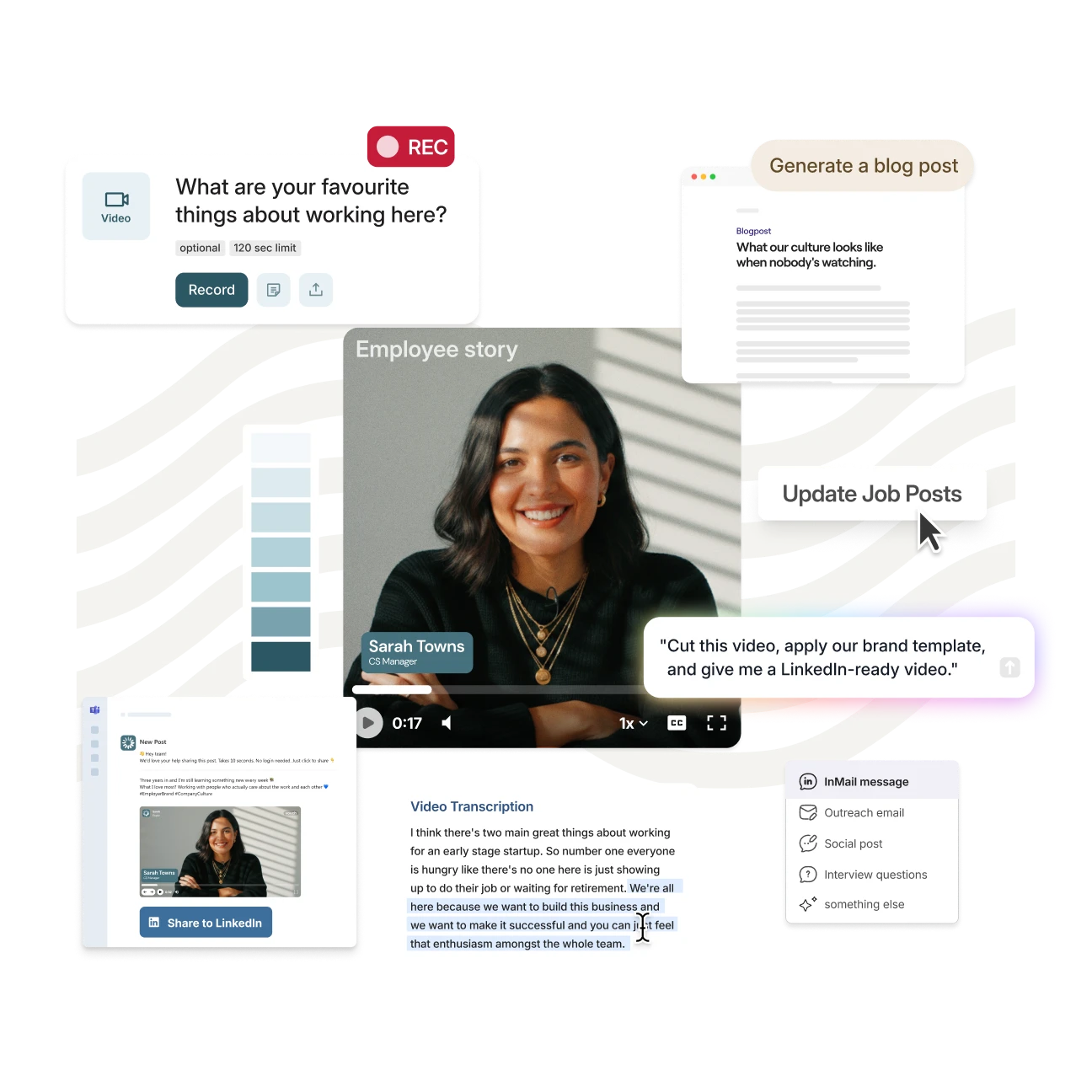
The most effective way to solve supply is employee self-capture with Vouch. Employees record short clips via a browser link or on their own device, in their own time. AI editing handles trimming, captioning and brand overlays. A piece of content that previously required a videographer, an editor and a half-day shoot now happens in five minutes with no specialist resource.
Flight Centre used Vouch to capture 1,100 employee stories across 30 brands in 90 countries, without a single video crew. The stories are now used across their careers page, LinkedIn and recruiter outreach.
Content planning tools
A simple editorial calendar tracking content type, persona target, channel, owner and publish date is enough to start. Sophistication in planning matters less than consistency in execution. A team publishing three authentic pieces of content per week will outperform a team publishing one polished campaign per quarter.
For ideas on what to produce, see 7 Corporate Video Types Your Company Should Make.
STEP 5: Choose Your Channels
Channel selection should follow your research rather than what is easiest for your team to manage. The right question is not "what channels does our company already use" but "where do our target candidates spend time and where are they making decisions about employers." The two are often not the same.
The table below goes beyond a simple list of channels and content types. Each row includes the strategic purpose of the channel and a benchmark for what good performance looks like, so you can move from planning to evaluation.
Prioritizing channels
For most employer brand teams, LinkedIn is non-negotiable for professional talent. The careers page is the conversion point and should receive the highest-quality content. Employee advocacy on LinkedIn consistently outperforms company page content because the algorithm favors personal posts and candidates trust personal voices over brand accounts.
Resist the temptation to be active everywhere. Two channels executed consistently outperform six channels executed sporadically. Pick those most relevant to your personas, establish a cadence, build a content library and then expand as capacity grows.
The careers page is a conversion tool, not a brochure
Most careers pages are designed to display job listings. The best-performing ones are designed to answer the question a candidate is actually asking: what will it genuinely be like to work here? Adding employee video to a careers page consistently increases application conversion rate. Role-specific testimonials addressing common candidate questions, day-in-the-life content and a clear EVP narrative turn browsers into applicants. Every priority role should have at least one employee video on its listing page.
STEP 6: Activate Employee Advocacy
Your employees are your most credible employer brand channel. Their personal LinkedIn networks reach audiences your company page cannot access, and candidates consistently say they trust employee content more than anything published by the brand itself. The challenge is rarely convincing employees to participate. It is removing the friction that stops them.
Why advocacy programs fail
Most advocacy programs underperform for one of three predictable reasons. Employees have to log into a new platform to participate, which most will not do consistently. The content they are asked to share does not feel relevant to their specific role or network. And there is no system for consistent delivery, so sharing happens in bursts at launch and then stops. The platforms and processes that solve all three of these problems at once are the ones that sustain participation past the first month.
What a working advocacy program looks like
Effective employee advocacy in 2026 works inside the tools employees already use. Content arrives in Slack or Microsoft Teams with a single click to share to LinkedIn. Employees do not need a new login, a new app or a caption, because the platform generates social copy in their brand voice that they can edit before posting. Vouch Employee Advocacy is built on this model: content is tagged by role, team or campaign so employees only receive what is relevant to them, AI generates the post copy aligned to your brand guidelines, sharing takes one click, and analytics show reach, engagement and which employees are driving the most impact.
Starting an advocacy program without a platform
If you are not yet using a dedicated advocacy tool, start with a small cohort of willing advocates: 5 to 10 employees across different teams and roles who are already active on LinkedIn. Give them pre-written content and a fortnightly sharing cadence. Measure the reach difference between their posts and your company page. That data makes a compelling internal business case for investing in a proper advocacy platform.
For a comparison of the leading advocacy platforms, see 10 Best Employee Advocacy Platforms (2026).
STEP 7: Measure What Matters
The employer brand teams that retain their budgets are the ones that can show leadership what the investment is producing. That requires the right metrics, established baselines and a reporting cadence that keeps employer brand on the leadership agenda. The table below is designed to do more than list metrics: each row includes a benchmark to aim for and a diagnostic question to help you interpret what the data is telling you.
Setting baselines before you launch
You cannot demonstrate improvement without a starting point. Before any new campaign or content initiative, document your current numbers across all four metric layers. Every initiative you run after that has a clear before-and-after to report against. This single discipline instantly transforms employer branding from a cost center into a function with demonstrable commercial impact.
Reporting cadence
Monthly reporting on the awareness and perception layers keeps the team tracking trends in near real time. Quarterly reporting on pipeline and outcome metrics gives leadership the business impact story. An annual EVP review closes the loop between strategy, employee sentiment and results.
Keep reporting simple. A one-page monthly dashboard with 3 to 5 core metrics and a brief narrative is more likely to be read and acted on than a 20-page deck. Frame every metric in the language that matters to your audience: cost, time and quality rather than reach and impressions.
Connecting content to outcomes
The most valuable measurement capability for employer brand teams is knowing which specific content pieces drive applications and influence hires. Vouch's analytics connect video performance to careers page traffic and ATS data so you can see not just how many people watched a video but whether it contributed to a hire. That closes the attribution gap that makes employer brand ROI difficult to prove to leadership.
For a detailed ROI framework and worked examples, see Proving Employer Branding ROI in 2026 and Employer Branding Analytics: How to Track and Measure Success in 2026.
STEP 8: Review, Iterate and Keep It Alive
An employer branding strategy is not a document you write once and file. The companies building sustained talent advantages treat their employer brand as a living program: continuously fed with new content, regularly tested against actual employee and candidate sentiment and updated when the business changes.
Quarterly content and channel review
Every quarter, review what content performed best and worst, which channels are generating the most qualified traffic and where participation is dropping off. Use these findings to adjust your content calendar and channel mix for the following quarter. What worked six months ago may not work today as the algorithms, the talent market and your workforce evolve.
Annual EVP review
Once a year, go back to employees with a short pulse survey. Does the EVP still reflect the actual experience? Have the company's values, culture or offering changed in ways that need to be reflected? Has the competitive landscape shifted so your differentiation is no longer distinctive? An EVP that reflects last year's company is an employer brand liability that candidates will notice before you do.
Feeding candidate data back into the strategy
Every hire and every failed hire contains information. Review candidate feedback surveys, exit interview themes from the first 90 days and Glassdoor reviews regularly. If a pattern of feedback suggests a gap between your EVP promise and the actual experience, address it at the source rather than papering over it with more content. No amount of employer brand activity compensates for a genuine culture problem.
Employer Branding Strategy: One-Page Reference Template
This table is designed to serve as an active working reference rather than a summary. Each step includes a realistic time estimate and the most common failure mode to watch for, so you can anticipate problems before they stall your program.
How Vouch Supports Your Employer Branding Strategy
The most common execution bottleneck in employer brand strategy is content supply: getting enough authentic, on-brand content without a production team or a monthly agency retainer. Vouch is built specifically to solve that problem, and it contributes across more steps of this framework than most teams initially realize.
- Audit: Vouch's content library shows you what employee-generated content already exists across your organization, who has participated, what topics have been covered and what is missing. Use this as part of your content audit before building a new program.
- EVP development: Employee interviews for EVP research are often the highest-friction part of the audit: scheduling calls, transcribing notes, finding themes. Vouch's async video capture lets you send employees a question set they answer in their own time via browser link, giving you richer, more candid responses than a structured interview and a library of proof points you can use directly in your EVP content.
- Content creation: Employees record short video clips via a browser link on any device. Vouch AI trims, captions and applies brand overlays automatically. A steady supply of authentic employee content becomes a production process rather than a one-off project.
- Channel activation: Vouch connects to your careers page and ATS, so employee videos are embedded directly on job listings and career site pages rather than sitting in a library no one uses. Videos are tagged by role, team and location so the right content reaches the right candidate in the right context.
- Employee advocacy: Vouch Employee Advocacy delivers content to employees via Slack or Teams with a single click to share to LinkedIn. AI generates the social copy based on your brand guidelines. No new login. No extra app. Employee participation actually happens.
- Measurement: Vouch MCP connects Vouch video performance to careers page traffic and ATS data, giving employer brand teams the attribution data they need to build an ROI case for leadership. See which specific videos are driving applications and influencing hires, not just which videos are being watched.
- Iteration: Vouch content analytics feed directly back into your quarterly review process. See which employee stories are resonating, which roles have content gaps and which channels are generating the most impact from employee-generated content. This closes the loop between creation and strategy in a way that manual reporting cannot.
Teams at MongoDB, Flight Centre, HubSpot, Culture Amp, Warner Bros. Discovery and Ericsson use Vouch as the content engine behind their employer branding strategy.
“Vouch helps us save so much time when recording employee video content. Things that used to take hours now just take a few minutes.” – Justin Stevens, Senior Talent and Communications Producer, SevenRooms
Conclusion
The companies with the strongest employer brands in 2026 did not get there through a single campaign or a one-off EVP exercise. They built a repeatable system: a clear articulation of what makes them genuinely distinctive as an employer, a scalable way to turn that into content, a distribution model that reaches candidates where they make decisions and a measurement framework that keeps employer branding connected to business outcomes.
The eight steps in this guide are designed to help you build that system. None of these steps requires a large team or an agency-sized budget. The teams that consistently outperform are not necessarily the biggest. They are the ones with the right process, the right technology and the ability to continuously capture and distribute authentic employee stories at scale.
That is the execution gap Vouch is built to solve.
Vouch helps employer brand and people teams capture authentic employee stories, turn them into polished content, distribute them across every channel and measure the impact on candidate engagement, applications and hiring outcomes. Instead of relying on one-off production shoots or inconsistent internal participation, teams can build a sustainable employer branding engine that scales with the business.
Ready to build an employer branding program that actually scales? Book a demo and see Vouch in action.
Frequently Asked Questions
How do you get leadership buy-in for employer branding?
Frame the business case in language your leadership team responds to: cost, time and quality rather than reach and impressions. The most compelling arguments are cost per hire reduction (companies with strong employer brands see up to 50% lower cost per hire, according to Vouch Employer Brand Statistics), improvement in offer acceptance rate and reduction in time to fill. Starting with a small, measurable pilot and reporting results to leadership within 30 days is the fastest way to convert skeptics.
For a detailed framework, see Proving Employer Branding ROI in 2026.
What makes an EVP distinctive rather than generic?
Most EVPs fail on specificity. The difference between a generic EVP and a distinctive one is proof. “We invest in your growth” is generic. “80% of our senior leaders were promoted internally” is specific, verifiable and memorable. Every pillar of your EVP should be backed by at least two or three proof points that only your organization can claim – data points, policies, programs or stories that a competitor could not copy and paste onto their own careers page. Run the test yourself: if you removed your company name from the EVP and gave it to a candidate, could they identify which company it belongs to? If not, it needs more specificity.
How much does employer branding cost?
The cost varies significantly depending on whether you build in-house or use agency support. Agency-produced video content typically costs $5,000–$30,000 per campaign. The more cost-effective approach is a purpose-built platform that enables employee self-capture and AI-assisted editing, eliminating reliance on video crews and reducing per-asset costs to a fraction of agency rates. Vouch is built around three capabilities that employer brand teams typically need: content creation and employer branding, employee advocacy and recruiter enablement. Teams can use one, two or all three depending on where their program is. For a framework on building the internal business case, see Proving Employer Branding ROI in 2026.
Can a small team run an effective employer branding strategy?
Yes, and some of the most effective employer brand programs are run by teams of one or two people. The key is choosing a process and tools that scale effort without scaling headcount. Employee self-capture removes the content production bottleneck. Advocacy tools remove the distribution bottleneck. A clear eight-step framework removes the strategy bottleneck. Small teams that execute consistently beat large teams that plan extensively and produce sporadically.
How do you keep employees engaged in an advocacy program long-term?
The three most reliable levers are relevance, recognition and habit. Employees disengage when they receive content that does not match their role or network, so role-based targeting is essential. Recognition – publicly celebrating top advocates in internal channels – sustains participation through social proof. Habit is built by delivering content inside tools employees already use daily rather than requiring them to check a separate platform. According to LinkedIn research cited by Vouch, companies with socially engaged employees are 58% more likely to attract top talent and 20% more likely to retain them – a result that reflects programs that have solved all three of these problems.
What does AI search mean for employer branding in 2026?
Generative AI tools like ChatGPT and Perplexity now mediate how many candidates research employers. When a candidate asks “Is [Company] a good place to work for engineers?” the answer is assembled from structured content on your careers page, Glassdoor reviews, LinkedIn data and third-party coverage – your official messaging may not feature at all if it is poorly structured or generic. Careers pages with clearly labelled sections covering pay philosophy, flexibility, career progression and culture give AI models something concrete to work with. Specific, verifiable claims (“68% of our employees moved roles internally in the past two years”) outperform generic positioning (“we believe in your growth”) in both human and AI evaluation. This is an increasingly important reason why EVP specificity and authentic employee content matter more in 2026 than they did in prior years.
How should we handle negative Glassdoor reviews?
Negative reviews are an opportunity, not just a problem. According to Glassdoor research, 71% of job seekers say their perception of a company improves when leadership responds to reviews. The most effective responses acknowledge the feedback specifically, describe what has changed or is being addressed and invite the reviewer to continue the conversation directly. Ignoring negative reviews signals to candidates that leadership is not listening. Responding defensively signals the same thing. What candidates respect is transparency: a company that says “we have heard this feedback and here is what we are doing about it” is more credible than one with only five-star reviews and no leadership responses.

You might also like
.webp)
.webp)


Elevate Your Brand Today With Vouch
Discover how Vouch can accelerate talent acquisition while helping you stay on-brand.