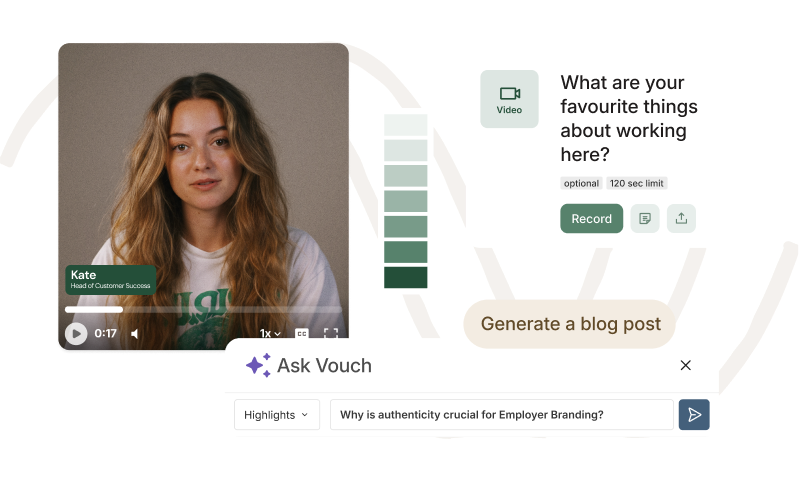
The most credible employer brand content is not produced by a marketing team. It is not written by a copywriter or staged by a videographer. It comes from the people who actually work at your organization, answering genuine questions about what the job is like, what the team is like and whether the reality matches what the company says about itself.
That is Employee-Generated Content (EGC), and it is one of the most significant shifts in how employer branding works in 2026. Candidates trust current employees three times more than company messaging when evaluating a potential employer (LinkedIn, via Vouch Employer Brand Statistics). EGC is the content type that makes that trust tangible.
This guide covers what EGC is, how it differs from UGC (user-generated content), the formats that work best and how Vouch helps employer brand and talent teams build a sustainable EGC program without a production budget.
Bring your employer brand to life
- Empower employees’ storytelling
- Transform careers sites with video
- AI-driven video editing
- Publish videos anywhere
What is Employee-Generated Content?
Employee-Generated Content is content created by employees about their experience of working at a company. It covers everything from a 60-second video answering what surprised them in their first three months, to a LinkedIn post about a project they just shipped, to a photo from a team offsite shared to their personal profile.
The defining characteristic is that it comes from a real person with real experience, not from the company's marketing function. It reflects what working there actually feels like rather than what the company wants candidates to think it feels like. That distinction is what makes it credible.
EGC sits at the intersection of employer branding and employee advocacy. On the employer branding side, it produces the authentic stories that a careers page, job listings and social channels need to attract candidates. On the advocacy side, it gives employees something worth sharing to their professional networks. The strongest programs do both at once.
EGC vs UGC: What’s the difference?
EGC is often confused with User-Generated Content, and the terms are sometimes used interchangeably. They are related but distinct. The table below covers the key differences.
The practical implication for talent teams: UGC strategies designed for marketing and consumer brands do not transfer directly to employer branding. The audience is different (candidates, not consumers), the trust signals are different (employee voices, not customer reviews) and the channels are different (LinkedIn and careers pages, not typically Instagram and product pages). EGC is a distinct content category that needs its own strategy.
Why EGC matters in 2026
Candidates are doing more research before they apply than ever before. Glassdoor reviews, LinkedIn posts from current employees and Reddit threads about company culture all give candidates access to information the company cannot control. In that environment, the choice is not whether candidates will find authentic content about the employer. It is whether that content comes from a structured EGC program or from uncoordinated, unedited sources the company has no input into.
A well-run EGC program puts the most credible voices, current employees speaking honestly about their experience, in front of candidates at the moment they are deciding whether to apply. The results show up across every metric that matters to a talent acquisition team.
Application volume
Job postings with video receive 34% more applications than those without. The most effective video format for job listings is employee story video: a current team member answering specific questions about the role and the team. No other content type generates the same level of candidate trust.
Offer acceptance rate
Candidates who have engaged with authentic employee content during the hiring process have a clearer picture of what they are saying yes to. At Culture Amp, Vouch became a tool used across the business, from customer advocacy through to recruitment. “Vouch just helps us achieve our goals and put a face and a voice behind everything that we’re doing,” says Anna Bryan, who leads Culture Amp’s Customer Advocacy program.
Early retention
Candidates who joined with an accurate picture of the role and the culture are better fits after joining. EGC that is specific and honest, particularly day-in-the-life video and new joiner reflections, directly reduces 90-day attrition by helping candidates self-select accurately before they apply.
Reach and brand awareness
Content shared by employees achieves 561% more reach than the same content from a company page. Flight Centre used Vouch to capture 1,100 employee stories across 30 brands and 90 countries, without a single video crew. The reach that generates would cost thousands in paid advertising to replicate.
EGC formats that work
Not all EGC performs the same way. The formats below cover the six types that consistently generate the strongest results, where each one belongs and what makes it work.
For specific question prompts across these formats, see 5 Employee Testimonial Questions: Updated for 2026.
What makes EGC successful
Three things separate EGC programs that compound over time from those that go quiet after month one: specificity, authenticity and consistency. Get those right and the bottleneck disappears.
Specificity
“What surprised you in your first three months?” produces better content than “Tell us about the culture here.” The more specific the question, the more specific the answer and specific answers are what candidates find credible. An employee describing exactly what their team does differently on a particular project is ten times more persuasive than an employee saying the company has a great culture.
Authenticity over polish
Overproduced EGC consistently underperforms authentic self-recorded content in recruitment contexts. Candidates can tell when a video was staged in a studio versus recorded genuinely in someone’s actual workspace. The production signals that the content was made by the company, not by the person speaking. Authentic does not mean low quality. Vouch handles the professional presentation automatically: AI trimming, captions in multiple languages and brand overlays mean the output is polished without being produced.
Volume and consistency
A single great employee video does not sustain an EGC program. The teams that see compounding results are those that produce a consistent flow of content: different employees, different teams, different questions, released regularly across careers pages, job listings and LinkedIn. Vouch’s async capture model is built for this. Employees record via browser link in their own time. Vouch AI processes each clip automatically. A session that would have taken a full production day now takes a few minutes of employee time and produces content for weeks.
How Vouch powers EGC at scale
Vouch is the AI content platform for talent teams, built specifically to make EGC operationally easy. The three problems that stall most EGC programs are production cost, employee participation and distribution. Vouch removes all three.
Capture without a crew
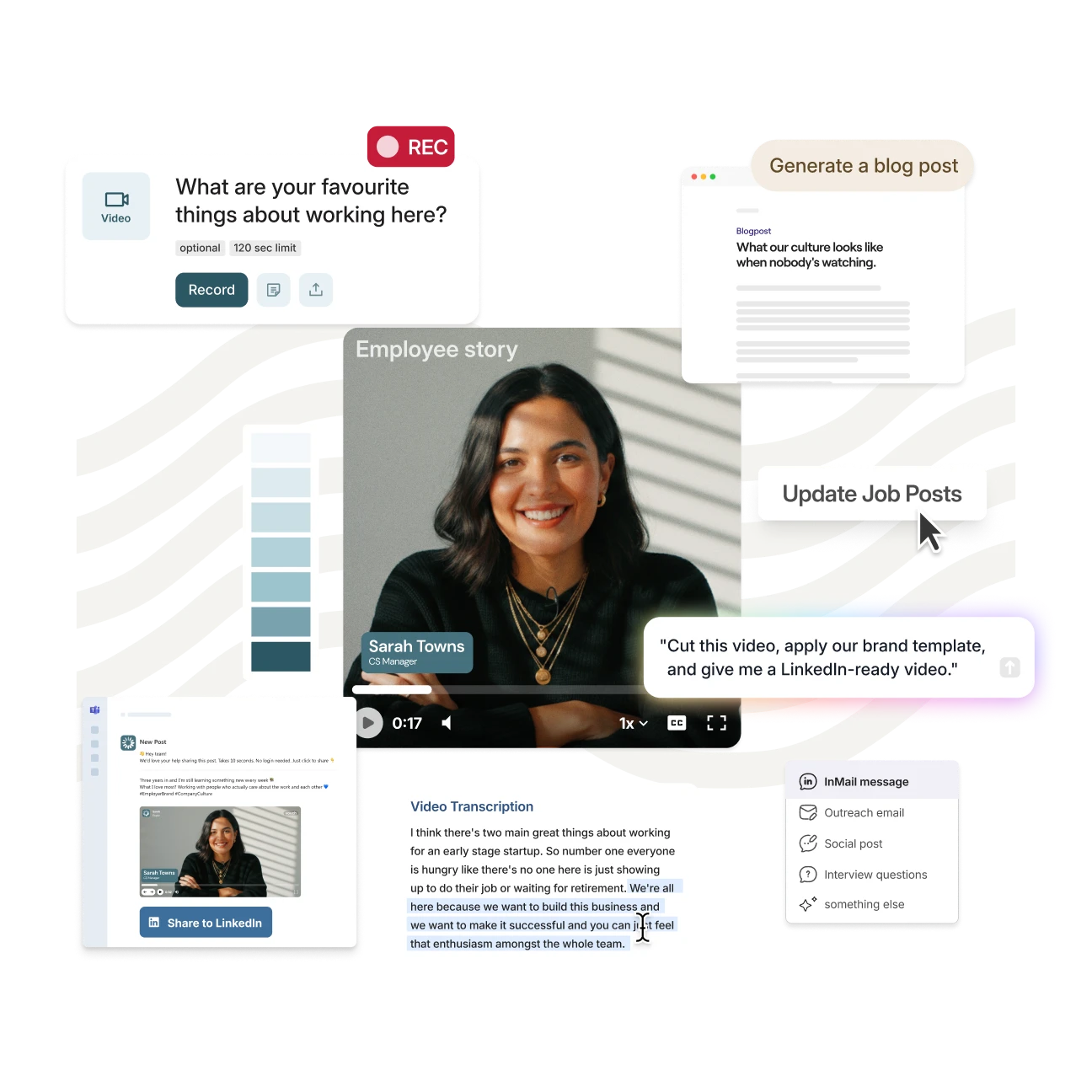
Employees get a browser link, answer a structured prompt in their own time on any device and Vouch AI handles the rest: trimming, captions in multiple languages and brand overlays. No downloads, no scheduling and no editing skills required. The content that comes back is authentic because it’s straight from employees.
Structured prompts that get honest answers
Vouch’s question prompts are designed to elicit specific, candid responses rather than generic ones. The difference between “Tell us about the culture” and “What would you tell a friend before they started here?” is the difference between a corporate-sounding post and something a candidate actually stops to watch.
Distribution across every channel
Vouch connects to careers pages and ATS platforms including Greenhouse, Lever and Workday so employee video is embedded on job listings at the point candidates are deciding whether to apply. Vouch Employee Advocacy delivers approved content to employees via Slack or Teams with one click to share to LinkedIn. AI-generated post copy means employees are not starting from a blank page.
Analytics that connect to hiring outcomes
Vouch analytics connects EGC performance to careers page traffic and ATS data. It shows which specific videos are driving applications and influencing hires, not just which ones are being watched. That closes the attribution gap that makes content ROI hard to prove to leadership.
Put together, that means an employer brand team can run a genuinely effective EGC program without a video crew, an agency or a patchwork of separate tools. Vouch handles capture, editing, distribution and measurement in one workspace, so the team's time goes into strategy rather than logistics. Teams at Mongo DB, NRMA, GoDaddy, Funlab, Flight Centre, and Culture Amp use Vouch to build and run their EGC programs.
How to get started with EGC
Most teams overcomplicate this. The fastest way to get an EGC program producing results is to start small and specific.
- Pick three employees who are active on LinkedIn and are promoters of your organisation. Not the most polished communicators, the most genuine ones.
- Give each one a single specific question. Not “Tell us about the role” but “What rituals does your team do on a Friday afternoon to end each week?”
- Send them a Vouch request link. Set a two-minute time expectation. Add instructions reiterating the recording does not need to be polished.
- Publish the clips to your careers page and your most active job listings. Share one per week via employee advocacy.
- Track application rate on listings with video versus those without. Set a baseline before you start.
Three employees answering one question each produces at minimum three pieces of content. That is enough to cover your first month. From there, expand the cohort, cut the clips into shorter versions using Vouch highlights, or add more questions and build the library systematically.
For a full guide to building the content program around your EGC, see the Employee Advocacy Content Guide. For the strategy layer, see the Employer Branding Strategy Guide.
EGC is the Employer Brand category worth owning
Most employer brand content is forgettable because most of it sounds the same. Awards won, culture values written by a committee, stock photography of people laughing in open-plan offices. Candidates have seen all of it and none of it tells them what they actually want to know.
EGC is different because it is specific and because it comes from real employees with real experiences. It answers the questions candidates are actually asking before they apply. And when it is built into a consistent program with structured capture, smart distribution and proper measurement, it compounds. Each piece of content keeps generating applications and building brand credibility long after it was recorded.
Vouch is the platform that makes EGC operationally viable at scale. Capturing authentic employee content without a crew, distributing it across every channel in the hiring funnel and connecting it back to hiring outcomes.
Want to see how EGC works in practice?
Vouch gives employer brand and talent teams the tools to capture authentic employee content at scale, get it in front of candidates and measure what it produces.
Book a 20-minute demo.
Frequently Asked Questions
Is EGC the same as employee advocacy?
They are related but distinct. EGC refers to the content itself: employee stories, videos, posts and culture moments created by employees about their experience. Employee advocacy is the distribution model: the structured program that gets that content shared by employees to their personal networks. The strongest programs do both. EGC without advocacy has no distribution engine. Advocacy without EGC has nothing worth sharing.
Does EGC have to be video?
No. EGC covers any content created by employees: video, written LinkedIn posts, photos, behind-the-scenes clips, new joiner reflections. Video is the highest-trust format and the one with the most impact on application rates, but text posts and culture moments also generate strong results, particularly for employees who are not comfortable on camera. A good EGC program includes a mix of formats.
How do you get employees to create content consistently?
Make it as easy as possible and give them a specific brief rather than an open one. A request link, a single question to answer in two minutes and a clear expectation that it does not need to be polished. Vouch’s structured prompts remove the blank page problem. Showing employees the results, how many people watched their clip, and how many candidates applied after seeing it, is one of the most reliable ways to sustain participation. For specific prompts, see 5 Employee Testimonial Questions: Updated for 2026.
How is EGC different from a company-produced employer brand video?
Company-produced employer brand video is created by a production team and reflects what the company wants to say about itself. EGC is created by employees and reflects what it is actually like to work there. Both have a place in an employer brand strategy, but they serve different purposes and perform differently. EGC consistently outperforms produced video in terms of candidate trust and engagement because it is unfiltered. The challenge historically has been production quality. Vouch solves this: employees record naturally and the platform handles editing, captions and brand presentation automatically.
How do you measure whether EGC is working?
The most meaningful metrics are application rate on job listings with EGC versus those without, video completion rate, offer acceptance rate for candidates who engaged with EGC during the process and careers page session duration. Set a baseline before introducing EGC so the improvement is visible. Vouch analytics connects video performance to careers page traffic and ATS data, making the chain from content view to application to hire measurable. For a full measurement framework, see Proving Employer Branding ROI in 2026.
Can a small team run an effective EGC program?
Yes. Some of the most effective EGC programs run today are managed by teams of one or two people. The key is a production model that does not require a crew or a budget. Vouch’s async capture model means a single team member can maintain a consistent content library across multiple roles and teams. Three employees answering one specific question each is enough to get started. The library grows from there.

You might also like
.webp)
.webp)


Elevate Your Brand Today With Vouch
Discover how Vouch can accelerate talent acquisition while helping you stay on-brand.