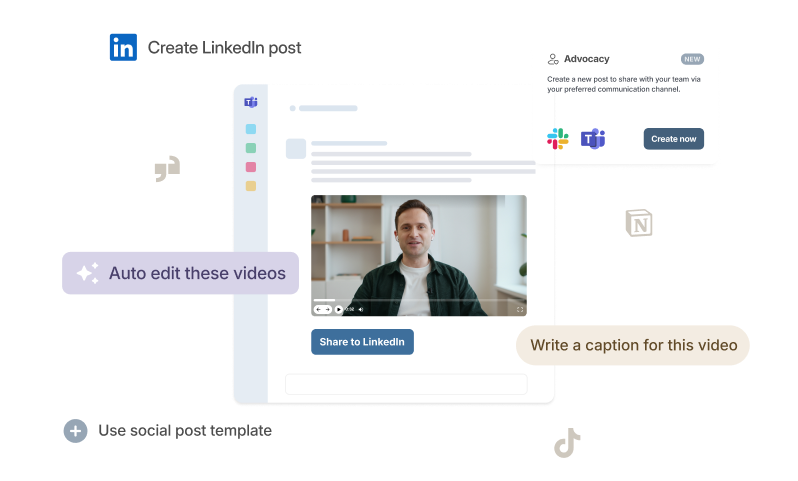
LinkedIn’s algorithm has shifted significantly in favor of personal voices over brand accounts, with organic reach for company pages falling 60–66% between 2024 and early 2026. Meanwhile, employee networks collectively reach far beyond what any company page can access, and content shared by employees generates 8x more engagement than the same post from a brand account. That gap is only growing.
An employee advocacy program is a structured response to that gap. Rather than relying on organic employee sharing, an advocacy program builds a system around it: the right content, delivered to the right employees, in the channels they already use, with the friction removed from sharing. For most employer brand teams, it is the highest-return distribution channel available.
Whether you are evaluating employee advocacy for the first time or trying to revive a program that has lost momentum, this guide aims to give you the full picture in one place.
The AI-enabled workspace for talent teams.
- Unified workspace for talent teams
- Accelerate hiring with AI tools
- Auto-generate polished hiring and employer brand content
- Easily repurpose assets across all channel
What is an Employee Advocacy Program?
An employee advocacy program is a structured system for encouraging and enabling employees to share approved content – videos, posts, job listings, culture moments – on their personal social media profiles, primarily LinkedIn. Unlike an informal expectation that employees will promote the company, a program provides content, tools, guidance and measurement so participation is consistent and results are trackable.
A few distinctions worth making:
- Employee advocacy is not asking employees to post whatever they want. Effective programs give employees pre-approved content and AI-generated social copy they can personalize before sharing. This protects brand consistency while preserving the authenticity that makes employee content credible.
- Employee advocacy is not a social media management tool. Social media management handles company channels. Advocacy operates through employees’ personal channels, reaching a fundamentally different audience with a different level of trust built from the people seeing the content.
- Employee Advocacy is not mandatory participation. The most effective advocacy programs are voluntary. Employees who share because they want to produce far better content than those who share because they are required to.
- Employee Advocacy is not a campaign. Campaigns have a defined start and end date. An advocacy program is an ongoing system with a content cadence, consistent delivery and regular measurement.
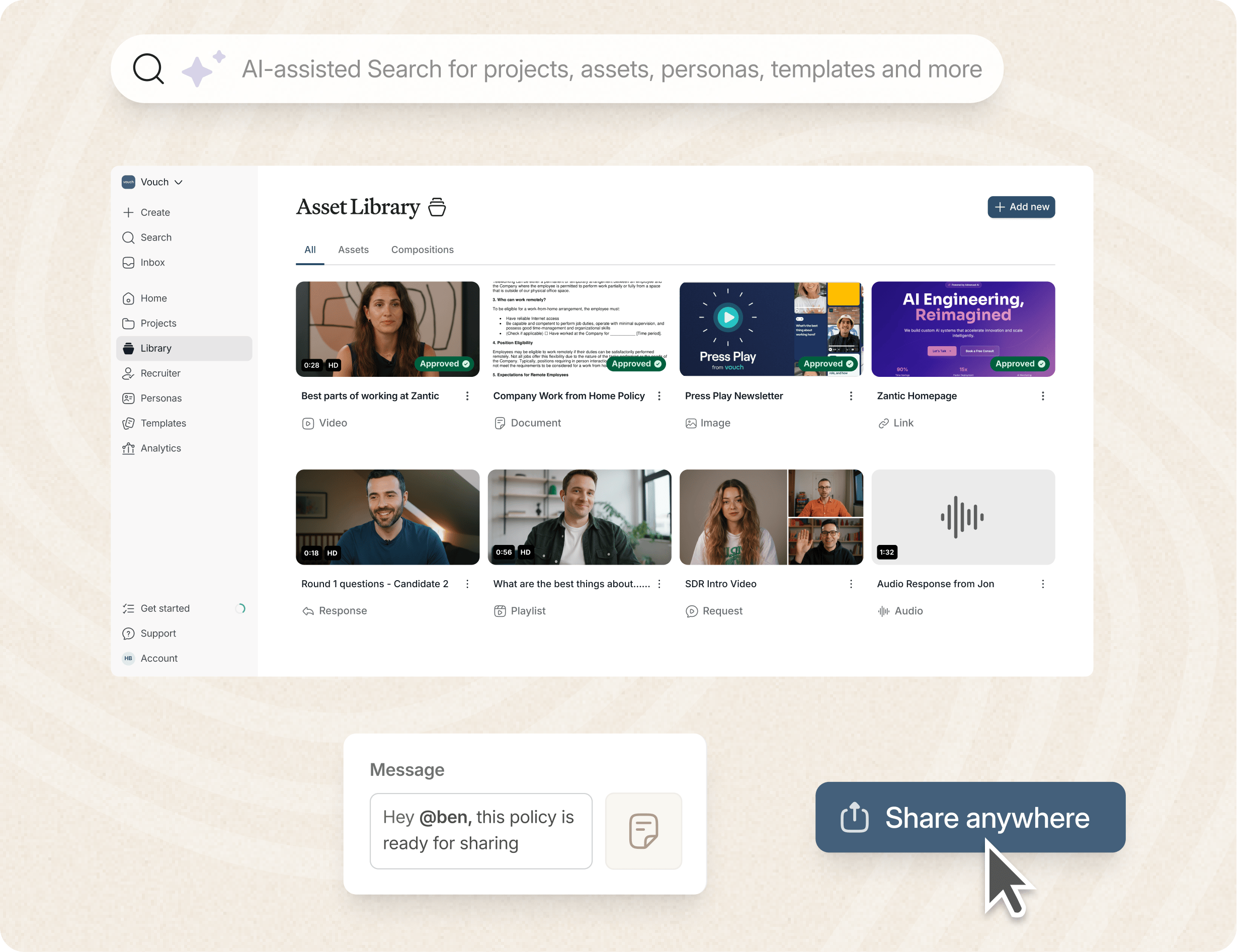
It is also worth distinguishing between two activities that most platforms treat separately but the strongest programs combine: content distribution (employees sharing approved brand content to their networks) and content creation (employees recording or writing original stories about their experience). Platforms that support both in one workspace, like Vouch, consistently deliver better results because they solve the supply and the distribution problem at the same time.
Why Most Employee Advocacy Programs Fail
Most advocacy programs lose momentum within the first six months, not because advocacy does not work, but because of how they are designed. Understanding the common pitfalls before building a program is one of the most valuable things a team can do.
Pitfall 1: Too much friction
The most common reason for advocacy drop-off is asking employees to do something outside their existing workflow. If employees have to remember to check a separate platform, download an app, create a new login or write their own post copy, most will not engage consistently past the first week. The programs that sustain participation are those where content arrives inside the tools employees already use, whether Slack, Microsoft Teams or email, with a single click to share to LinkedIn. Vouch Employee Advocacy is built on this model, with no login required and AI-generated social copy aligned to your brand guidelines that employees can edit before posting.
Pitfall 2: Irrelevant content
Sending the same content to every employee at the same time produces noise rather than engagement. A software engineer and a sales manager have different networks, different audiences and different content that resonates with their connections. The programs that sustain participation are those that create & distribute content by role, team and campaign, so employees receive only what is genuinely relevant to their specific network.
Pitfall 3: No system for sustained delivery
A common pattern in advocacy programs is strong participation in the first week, followed by a steady drop as the content queue empties and the novelty fades. Without a consistent delivery cadence, advocacy becomes sporadic and easy to deprioritize. Programs with a predictable fortnightly or monthly content flow maintain participation at a significantly higher rate than those without a defined cadence.
Pitfall 4: No leadership involvement
When leadership participates visibly, it is one of the most reliable indicators that a program will succeed. When leadership shares content, it signals to the rest of the organization that advocacy is a real priority rather than a delegated initiative. High-performing advocacy programs consistently involve senior executives, and those with visible leadership participation see higher employee engagement and stronger internal adoption.
The Business Case for Employee Advocacy
The business case for employee advocacy rests on three things that paid advertising cannot replicate: organic reach at a scale only employee networks can generate, the credibility that comes from a real person rather than a brand account, and hiring outcomes that can be directly attributed to content activity.
Reach
- Content shared by employees achieves 561% more reach than the same content shared from a company page.
- Employees collectively have approximately 10x more first-degree connections than the company page has followers
- 83% of employees feel more engaged when their company encourages advocacy
- Engaging just 50 active employees generate reach that would cost thousands in paid advertising to replicate (LinkedIn)
Trust
- An employee’s voice is up to 3x more credible than the CEO’s when candidates are evaluating a company as an employer (LinkedIn, via Vouch Employer Brand Statistics)
- 92% of consumers trust recommendations from people over branded content – in B2B contexts this trust differential is even more pronounced for employee voices vs corporate messaging
- Leads from employee-shared content convert at a rate 7x higher than other content types
- Click-through rate on employee-shared content is approximately 2x higher than brand-shared content
Hiring outcomes
- Companies with socially engaged employees are 58% more likely to attract top talent and 20% more likely to retain them
- Employee advocacy programs consistently drive meaningful increases in LinkedIn traffic to careers pages, as employee-shared content reaches candidate networks that company page posts cannot access
- Leads generated through employee advocacy convert at a significantly higher rate than those from traditional lead generation, because they arrive pre-warmed through trusted personal connections rather than cold outreach
Cost
- Flight Centre captured 1,100 employee stories across 30 brands and 90 countries using Vouch, replacing what would otherwise have been an agency production budget (Vouch customer data)
- Companies with strong employer brands see up to 50% lower cost per hire – advocacy is one of the primary channels through which employer brand strength compounds over time
- Traditional agency-produced video content typically costs $5,000–30,000 per campaign. Employee self-capture with Vouch reduces per-asset costs to a fraction of that, removing the production bottleneck without sacrificing authenticity
- Only 3% of employees share company content, but those shares generate approximately 30% of a brand’s total LinkedIn engagement – a disproportionate return that makes even a small, active advocate cohort highly cost-effective
- Employee referrals cost up to 50% less per hire than candidates sourced through job boards - advocacy programs that increase referral volume compound this saving across every hire influenced by employee-shared content
How to Build an Employee Advocacy Program: 6 Steps
Skipping the first two steps and going straight to platform selection is one of the most common reasons advocacy programs lose momentum early – the result is a program built without clear goals or internal support, which no platform can compensate for.
STEP 1: Secure Leadership Buy-In
Senior sponsorship is what converts an advocacy program from a side project into an effective hiring channel. Building the internal case means connecting advocacy to the metrics leadership already cares about: cost per hire, offer acceptance rate, reach per dollar of marketing spend and time to fill.
A credibility argument tends to resonate with leadership more than a reach argument. According to Vouch Employer Brand Statistics, an employee’s voice is up to three times more credible than the CEO’s when candidates are evaluating a company as an employer – framing advocacy as a trust-building strategy rather than a social media tactic tends to land better with senior audiences.
Beyond budget and permission, the most valuable thing to secure from leadership is their own participation from the start. Programs with visible executive advocates from day one consistently see stronger internal adoption than those where advocacy is delegated entirely to HR or marketing. Three or four senior leaders sharing content in the first week sets the tone for the rest of the organization.
STEP 2: Define Goals and KPIs
The three most common goals for employer brand teams are:
- Talent attraction. Increasing application volume and quality through employee-driven reach on LinkedIn. KPIs: careers page traffic from advocacy sources, application volume, offer acceptance rate.
- Brand awareness. Growing share of voice on LinkedIn in the target talent market. KPIs: organic reach, total impressions, follower growth on the company page as a downstream effect of employee sharing.
- Employee engagement. Using advocacy as an internal engagement program that increases employees’ connection to the brand. KPIs: participation rate, content submission rate, eNPS trend.
Documenting current careers page traffic, application volume and offer acceptance rate before the first content goes out gives a clear before-and-after to report to leadership within the first 90 days. Without a baseline, demonstrating progress is difficult regardless of how well the program performs. For a full measurement framework, see Employer Branding Analytics: How to Track and Measure Success in 2026.
STEP 3: Recruit a Pilot Cohort
Rather than launching to the full company, most successful programs begin with a pilot cohort of 10 to 25 employees. The pilot serves three purposes: it generates proof-of-concept data to take back to leadership, it surfaces what content and formats perform best before scaling, and it creates a group of internal advocates who model the behavior for the rest of the organization when the broader rollout happens.
The strongest pilot cohorts are drawn from employees who are already active on LinkedIn, who have a meaningful following in the target talent pools, and who span different teams, seniority levels and locations. Diversity in the cohort produces better content variety and wider network reach than pulling from a single team or function.
Running the pilot for 30 to 60 days before expanding gives enough data to identify what is working and address any friction before it scales. If participation drops off after the first two weeks, the delivery model likely needs adjustment before the program goes company-wide. A drop in participation at this stage is a signal rather than a failure, and far easier to fix in a pilot than after a full rollout.
STEP 4: Build the Content Engine
Running out of content is a more common reason for programs losing momentum than low participation. A sustainable content engine addresses supply before distribution, because even the most frictionless delivery system cannot keep a program alive if there is nothing to send to employees.
Content for distribution
The content that already exists is the easiest place to begin: job listings for priority roles, blog posts and thought leadership, culture moments and team announcements, employer brand videos already in the library. Pre-approving this content for employee sharing, tagging it by role and team, and loading it into the advocacy platform creates an immediate content library without requiring new production.
Content for creation
Employee-generated video consistently generates the strongest engagement and trust of any content format available to employer brand teams. The challenge for most teams is volume: getting enough authentic employee video without a production budget or a dedicated video team.
Vouch is built specifically to solve this problem. Employees receive a browser link, answer a structured prompt in their own time on any device, and Vouch AI trims, captions and applies brand overlays automatically. Content that would previously have required a full production day can be captured, edited and ready to publish in under five minutes. For prompt ideas, see 5 Employee Testimonial Questions: Updated for 2026.
STEP 5: Choose a Platform
By this point, the goals are set, the pilot cohort is identified and the content needs are clear. Platform selection works best at this stage rather than earlier, because knowing what the advocacy program needs to do makes it far easier to evaluate which platform actually fits your goals. For teams that need to solve content creation and distribution together, Vouch is the only platform that handles both natively, combining employee video capture, AI editing and one-click LinkedIn advocacy in a single workspace.
Regardless of which platform is evaluated, three capabilities have the largest impact on long-term program success:
- Friction-free delivery. Content that arrives inside Slack, Microsoft Teams or email with a single click to share to LinkedIn consistently maintains participation at a higher rate than content requiring employees to visit a separate platform. The drop-off from adding even one extra step is significant.
- Role-based content targeting. Every employee should receive only content relevant to their specific role, team or location. Sending the same content to everyone produces noise, depresses sharing rates and is one of the most common reasons participation declines after the first month.
- AI-generated post copy. Providing employees with a draft post in the brand voice that they can edit into their own voice before posting removes the single biggest friction point in advocacy: not knowing what to say. Platforms that include this capability see meaningfully higher sustained participation rates than those that require employees to start from scratch.
For a full side-by-side comparison of the leading advocacy platforms, see 10 Best Employee Advocacy Platforms (2026). For a broader evaluation including employer branding tools beyond advocacy, see the Employer Branding Software Buyer’s Guide.
STEP 6 : Launch, Measure, and Iterate
Launching with the pilot cohort rather than the full company gives the program a controlled environment to generate the first results. The first content batch works best when it is accompanied by clear context about what the program is trying to achieve and a brief message of support from a senior leader, rather than a generic all-company announcement.
Following up within 48 hours with the reach numbers from the first shares makes the impact tangible for participating employees and drives further sharing. Seeing that a post reached several thousand people is one of the most reliable drivers of continued participation, because advocacy stops feeling abstract and starts feeling effective.
Tracking participation rate and reach closely in the first 30 days identifies any friction or content relevance issues before they become embedded patterns. Quarterly reporting to leadership on hiring outcomes, covering careers page traffic, application volume and offer acceptance rate, keeps employer brand investment on the agenda and builds the case for expanding the program over time.
What Content Works Best for Employee Advocacy
The content that performs best for employee advocacy on LinkedIn in 2026 tends to feel personal and specific rather than corporate and generic. The LinkedIn algorithm explicitly favors original perspective over shared brand content, and audiences have become increasingly skilled at identifying and skipping posts that read as if they came from a marketing team rather than a real person.
The formats generating the strongest results for employee advocacy, in order of typical performance:
- Short video (60–90 seconds). Employees answering a specific question in their own words, ideally a question a candidate would genuinely want answered: what does a typical week look like in your role, what surprised you after joining, what makes the team different. The specificity is what makes it credible.
- LinkedIn document posts. PDF-format carousel posts with a clear insight or framework. The LinkedIn algorithm distributes native documents significantly more widely than posts with external links, making this format particularly effective for thought leadership and role-specific expertise.
- Personal story text posts. An employee sharing a specific experience, a decision made or something learned. The more specific the detail, the better it performs. A post that begins “I’ve been in this role for three years and this is what has changed” consistently outperforms one that says “great company to work for.”
- Job listing shares with a personal endorsement. The highest direct hiring conversion of any advocacy format. Candidates who discover a role through an employee’s personal network arrive with a pre-existing level of trust and familiarity that candidates from job boards rarely have.
Generic company announcements without a personal angle, polished produced video that looks corporate, and content that reads as pre-written all consistently underperform. For a full breakdown of employee video content types and prompts, see 7 Corporate Video Types Your Company Should Make.
How to Sustain Participation Beyond the First Month
Whether a program maintains participation past the first month is one of the most reliable early indicators of whether it will sustain over time. Programs that hold participation through the first 30 days almost always continue to do so. Those that do not typically require a meaningful redesign rather than incremental adjustment.
Three factors drive sustained participation:
Relevance
The fastest way to erode participation is to send irrelevant content to employees. A software engineer does not want to share a post about the sales culture, and a recruiter in one market does not want to amplify a role in another. Tagging every piece of content by role, team, seniority and campaign, so employees receive only what is genuinely relevant to their network, has more impact on sustained participation than almost any other program design decision. Vouch’s targeting system handles this for you, with each employee seeing only the content tagged for their profile.
Recognition
Employees who are publicly recognized for their advocacy are significantly more likely to continue participating. Recognition inside internal channels – a Slack message celebrating the week’s top advocates, a monthly leaderboard shared in a team meeting, a specific mention from a senior leader – builds the social proof that normalizes advocacy as a behavior. It makes the activity visible to other employees and signals that it is valued by the organization.
Habit
Advocacy participation is sustained by routine rather than novelty. The programs with the strongest long-term participation rates are those with a consistent delivery cadence, typically fortnightly or monthly, so employees come to expect new content and build the habit of sharing it. Delivery inside Slack or Teams rather than a separate platform is essential because it slots into an existing daily workflow, whereas a separate platform requires employees to build an entirely new behavior around remembering to check another tool.
“Vouch helps us save so much time when recording employee video content. Things that used to take hours now just take a few minutes. It saves time, not only for myself but saves time for any employee that we’re featuring in the video.” – Justin Stevens, Senior Talent and Communications Producer, SevenRooms
Measuring Your Employee Advocacy Program
Measurement is what keeps an advocacy program funded. Measurement across four layers (participation, reach, engagement and business outcomes) is what separates a program that retains its budget from one that gets cut at the next review.
For the full measurement framework including cost per hire attribution and offer acceptance rate tracking, see Proving Employer Branding ROI in 2026.
How Vouch Supports Every Stage of an Advocacy Program
Vouch is the only advocacy platform that addresses both sides of the content problem in one workspace: getting enough authentic content created, and getting it distributed efficiently. For employer brand teams starting from a low content base, this distinction matters. A distribution-only platform amplifies nothing if the content queue is empty.
Content creation
Employees receive a browser link, record their response to a structured prompt in their own time on any device, and Vouch AI trims, captions and applies brand overlays automatically. No downloads, no scheduling and no editing skills required. Flight Centre used this approach to capture 1,100 employee stories across 30 brands and 90 countries without a single video crew.
Content targeting and delivery
Approved content is tagged by role, team, location and campaign and delivered directly to employees inside Slack or Microsoft Teams. Employees share to LinkedIn in one click, with Vouch AI generating post copy in the brand voice that they can edit into their own voice before posting. There is no separate login, no new app and no blank page to stare at.
Careers page and ATS integration
Vouch connects to careers pages and ATS platforms including Greenhouse, Lever and Workday. Employee video content is embedded directly on job listings and career site pages, so advocacy reaches candidates at the point of decision rather than only on social media. This integration is what connects advocacy activity to measurable hiring outcomes.
Analytics and ROI reporting
Vouch analytics tracks reach, total impressions, content performance, earned media value and top advocates across the full program. The dashboard connects video performance to careers page traffic and ATS data, so it is possible to see not just how many people watched a video but whether it contributed to a hire. That closes the attribution gap that makes advocacy ROI difficult to prove to a leadership team.
EVP research and content audit
Vouch’s async video capture is also an effective way to collect employee insights during EVP development. Sending employees a structured question set they answer in their own time via browser link produces richer and more candid responses than scheduled interviews, and the resulting clips serve as proof points that can be used directly in advocacy content.
Teams at MongoDB, Flight Centre, HubSpot, Culture Amp, Warner Bros. Discovery and Ericsson use Vouch as the content engine behind their advocacy programs.
Conclusion
Employee advocacy is no longer a nice-to-have for employer brand teams. As organic reach on company pages continues to decline and candidates place more trust in people than brands, employee networks have become one of the most valuable distribution channels available. The organizations seeing the strongest results are not relying on ad hoc employee sharing. They are building structured programs that make advocacy easy, relevant and sustainable over time.
Vouch was built specifically for modern employer brand and advocacy teams. By combining employee video capture, AI-powered editing, role-based content distribution and one-click LinkedIn sharing in a single platform, Vouch helps organizations scale authentic employee advocacy without adding complexity for employees or lean internal teams. From EVP research and employee storytelling through to advocacy distribution and ROI reporting, Vouch supports every stage of the process in one connected workflow.
Whether you are launching your first advocacy pilot or scaling an established employer brand program globally, the companies building the strongest talent brands in 2026 are the ones empowering employees to become their most trusted voices.
Ready to see what that could look like for your team? Book a demo with Vouch to see how leading employer brands are capturing authentic employee stories, scaling LinkedIn advocacy and measuring real hiring impact from one platform.
Frequently Asked Questions
How is employee advocacy different from employee-generated content (EGC)?
Employee-generated content refers to any content employees create about their experience (videos, photos, written posts) that the company then publishes on its own channels. Employee advocacy is the reverse: the company creates or approves content and employees share it to their personal channels. The two are complementary and the strongest programs combine both. Vouch is designed specifically to support this combination: employees record their own authentic stories, those stories are edited and approved by talent and employer brand teams, and then distributed back to employees for sharing on LinkedIn. The result is content that is both employee-generated and systematically distributed.
Should we use gamification and incentives in our advocacy program?
Recognition and friendly competition are two of the most effective levers for sustaining advocacy participation over time. Leaderboards, badges and points make sharing visible and socially rewarding, and when employees can see how their contributions stack up, participation tends to compound rather than fade. Vouch makes this straightforward: it surfaces your top advocates automatically, shows program managers exactly who is driving reach and engagement, and gives you the data you need to recognise and reward the right people publicly. Calling out your top advocates in a team meeting or Slack channel, backed by real numbers, builds the social proof that keeps the wider program active. The teams that get the most from recognition features are those that pair them with relevant, well-targeted content, because employees who share because the content genuinely resonates with their network consistently outperform those sharing purely for points.
How do you handle employees who are not comfortable on social media?
Not every employee needs to be an active advocate, and the most effective programs are opt-in rather than mandatory. A small cohort of genuinely willing participants produces better results than a large mandatory program where participation is reluctant. For employees who want to participate but lack confidence, the most common barriers are not knowing what to say and uncertainty about what is appropriate to share. Both are addressed by providing specific prompts, pre-written post copy employees can edit and clear guidelines. Vouch’s AI-generated social copy gives employees a draft post they can personalize rather than starting from scratch.
How do you get executive buy-in for an employee advocacy program?
A credibility argument tends to resonate with leadership more than a reach argument. According to Vouch Employer Brand Statistics, an employee’s voice is up to three times more credible than the CEO’s when candidates are evaluating a company as a potential employer. Framing advocacy as a trust-building strategy rather than a social media tactic tends to land better with senior audiences. Running a small pilot and sharing the results with leadership within the first 30 days is one of the most effective ways to build genuine internal support.
What is the difference between employee advocacy and social selling?
Social selling is a sales function that uses personal LinkedIn profiles to build relationships with prospects, engage with leads and accelerate pipeline. Employee advocacy is primarily a brand and recruiting function that uses employee networks to amplify content about the company’s culture, values, thought leadership and open roles. The audiences, the content types and the goals are different, though the platforms overlap. Sales teams are increasingly involved in advocacy programs as the boundary between the two functions blurs, and the most effective platforms support both use cases.
Can advocacy content hurt your employer brand if employees post the wrong thing?
This is the most common objection to starting an advocacy program and it is worth addressing directly: the risk is real but manageable, and it is significantly lower than most leaders assume. Effective programs work with pre-approved content that employees can share in one click, rather than asking employees to create and post their own unreviewed content. AI-generates post copy in your organization’s brand voice, and employees are able to personalize before posting. This gives teams meaningful control without making the content feel scripted. Clear brand guidelines and a simple content approval workflow address the edge cases. The far more common outcome of well-designed advocacy programs is a measurable improvement in employer brand perception, not damage to it.
Can a small employer brand team run an effective advocacy program?
Some of the most effective programs running today are managed by teams of one or two people. The key is choosing a platform that removes the production and distribution bottleneck, so the team’s role is strategy and measurement rather than chasing employees for content or manually coordinating a content calendar. Vouch’s employee self-capture, AI editing and automated Slack and Teams delivery mean a small team can maintain a consistent program that would previously have required a videographer, an editor and a separate advocacy platform.

You might also like
.webp)
.webp)

Elevate Your Brand Today With Vouch
Discover how Vouch can accelerate talent acquisition while helping you stay on-brand.