Employer brand content rarely gets held up because someone can’t think of an idea. The delays usually happen around the content itself: finding the right employee, sending the brief, following up, collecting feedback, waiting for approval and then working out where the final asset should live.
When every story needs that much manual coordination, even a simple content request can take longer than it should.
A better employer brand content workflow doesn’t need to be complicated. It needs to make the repeatable parts of the process easier for your team, employees and the stakeholders involved.
Bring your employer brand to life
- Empower employees’ storytelling
- Transform careers sites with video
- AI-driven video editing
- Publish videos anywhere

Where employer brand workflows usually slow down
Most employer brand teams already have a process for creating content. The problem is that parts of it often live across different tools, folders, messages and people.
One employee request might start in Slack, move into email for approval and end with the final video saved in a shared drive. A few months later, someone needs the story again and nobody is quite sure where the approved version lives.
The same friction tends to show up around:
- Content requests and employee follow-up
- Unclear briefs or prompts
- Too many reviewers
- Waiting for stakeholder feedback
- Finding approved content
- Knowing what can be reused
- Getting content to recruiters and other teams
You probably can’t remove every handoff. You can make them easier to manage.
Build a simpler workflow from the start
A good workflow makes it clear what needs to happen, who needs to be involved and what comes next. It should also support your wider content strategy, so every request has a clear purpose before you ask an employee to create anything.
Start with a clear content request
Be clear about why you need the content, who it’s for and what you want the employee to talk about.
Broad requests usually create more work. Asking someone to “share their experience working here” leaves a lot for them to figure out. A focused question about career progression, team culture or what surprised them in their first few months gives them somewhere to start.
Your request should also make the practical details clear. What format do you need? When do you need it? How much time should it take?
The easier the request is to understand, the less back and forth you’re likely to need later.
Keep reviews and approvals clear
Before production starts, know who actually needs to review the content. Not every employee story needs to move through employer brand, talent acquisition, marketing, communications, legal and a hiring manager.
Some content will need more review than others. What matters is having that clear upfront rather than adding stakeholders halfway through the process.
When ownership is clear, there’s less chasing, fewer duplicate comments and less time waiting for someone to make the final call.
Organize content so it’s easy to find
The workflow shouldn’t stop when an asset is approved. Staff need to know where that content lives, what it covers and whether it can be used again.
Keep enough information with each story so your team can quickly understand:
- Who’s featured
- What they talk about
- Which role, team or location it relates to
- Whether it’s approved
- Where it can be used
- Whether the information is still current
That makes the next request easier too, because you can check what already exists before starting again.
Make reuse part of the workflow
Employer brand teams don’t need to start from scratch every time someone asks for content.
Before creating something new, look at what you already have. An older interview might answer the same candidate question. A longer video might contain a clip you haven’t used yet. A story created for one hiring campaign may still be useful somewhere else.
It also helps to think about reuse while you’re capturing the story. One employee conversation might give you a careers page quote, a short social clip and an answer a recruiter can share directly with candidates.
That doesn’t mean turning every story into ten different assets. It means getting more value from the employee participation and coordination you’ve already invested in.
Make distribution easier
A finished asset isn’t very useful if nobody knows it exists. Distribution should be part of the workflow, not something you think about once the content is finished.
Give recruiters access to relevant content
Recruiters are already having conversations with candidates, so make it easy for them to find employee stories that support those conversations.
Organizing content by role, location, topic or candidate question can make it much easier to find the right story without asking employer brand every time. It also means useful content has a better chance of being used beyond the campaign it was originally created for.
Use the right story in the right places
Not every story needs to go everywhere.
A short employee clip might work well on social, while a more detailed story may be better on your careers site or in recruiter outreach.
Start with the audience and the question the content is answering, then choose the channels that make sense. You don’t need to add another channel just because it’s there.
A simple employer brand content workflow
You don’t need a complicated process to keep content moving. A simple workflow might look like this:
| Stage | What to focus on |
|---|---|
| Request | Clear purpose, audience, prompts and deadline |
| Capture | Useful employee stories with a clear focus |
| Review | The people who genuinely need to be involved |
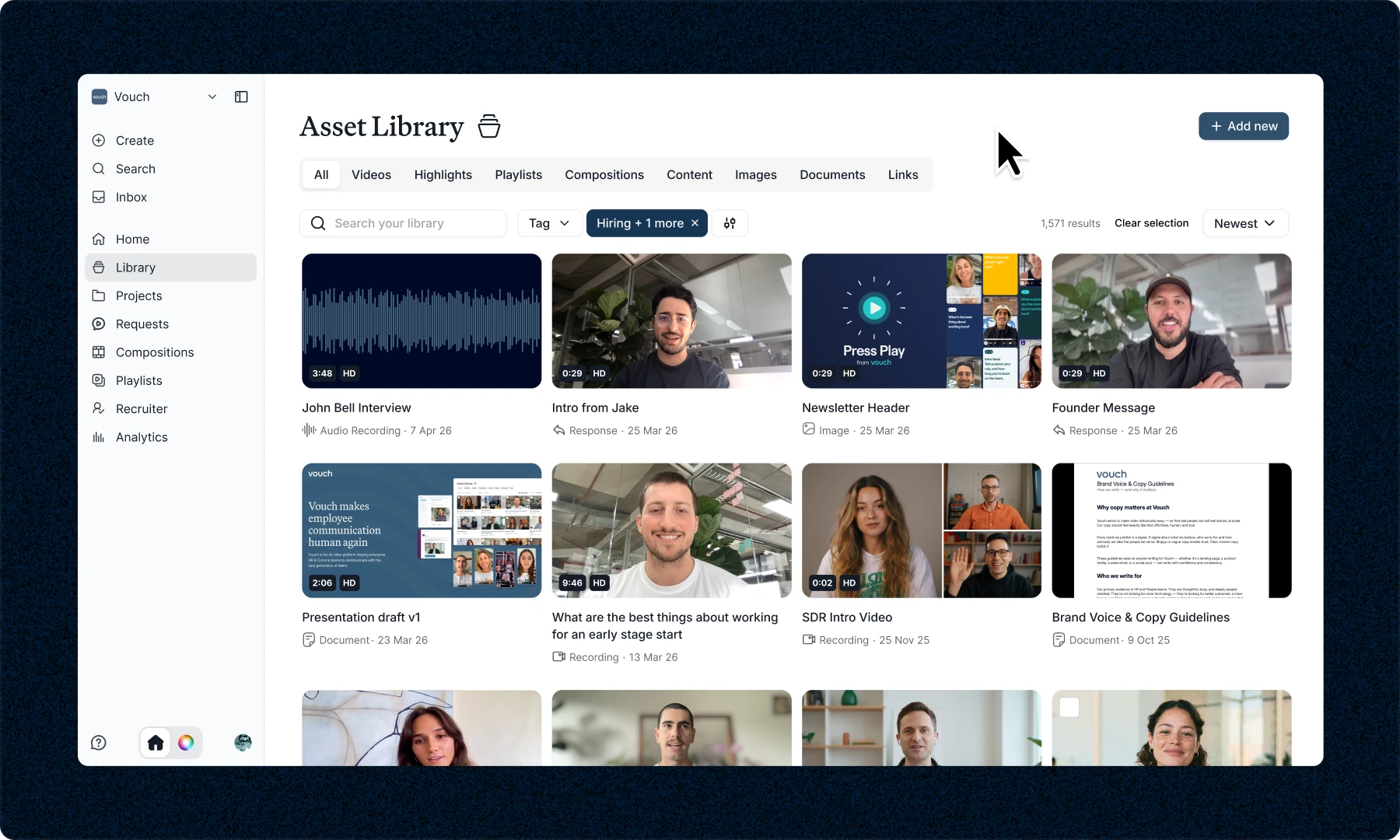
| Organize | Approved content that's easy to find |
| Distribute | Recruiters and the channels where the story is useful |
| Reuse | Existing stories before starting another request |
The details will look different for every team, but the principle is the same. Everyone involved should be able to understand what happens next without you having to manually push every step forward.
That’s also where a better workflow can help reduce the Coordination Tax, the hidden work that builds up around briefs, reminders, approvals, handoffs, asset searches and stakeholder follow-up.
Keep the workflow repeatable
The best employer brand content workflow isn’t the one with the most stages, tools or documentation.
It’s the one your team can actually use again.
If every new employee story needs a different process, the work becomes harder to manage as requests increase. A repeatable workflow gives you a clearer path from request to approved content without having to work out the process again each time.
At Vouch, we give employer brand teams one place to capture employee stories, keep content organized and make approved assets easier to find and reuse. If you want to see how Vouch can support your team, you can book a demo.
The goal is simple: spend less time managing the process around the content and more time getting useful employee stories where they need to go.

You might also like
.webp)
.webp)

Elevate Your Brand Today With Vouch
Discover how Vouch can accelerate talent acquisition while helping you stay on-brand.