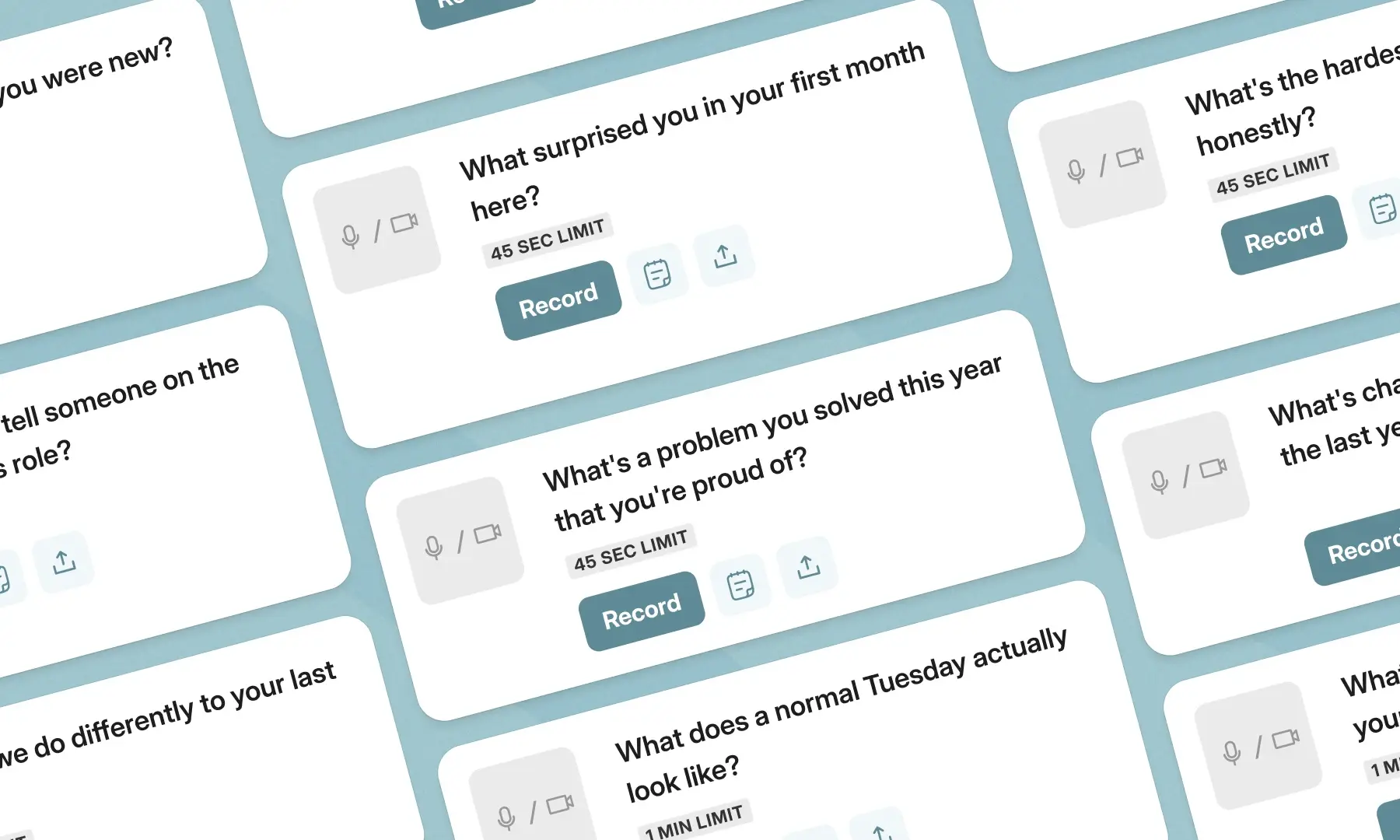
Employer Brand Content Request Template: What to Ask Employees and Stakeholders
Employer brand teams rarely run out of content ideas. The harder part is getting the right people to contribute, collecting what stakeholders need and moving each asset through review without weeks of chasing.
A vague request looks quick. In practice, it creates more work. Employees do not know what to say, managers are unclear on the objective and approvers join the process after the content has already been recorded.
For a lean employer brand team, that hidden work adds up fast.
A structured employer brand content request gives employees enough direction to participate confidently and gives stakeholders the information they need before production begins. It removes avoidable back-and-forth without scripting the story out of the employee.
This guide includes a complete request template, practical employee prompts and the questions to settle internally before you hit send.
Bring your employer brand to life
- Empower employees’ storytelling
- Transform careers sites with video
- AI-driven video editing
- Publish videos anywhere
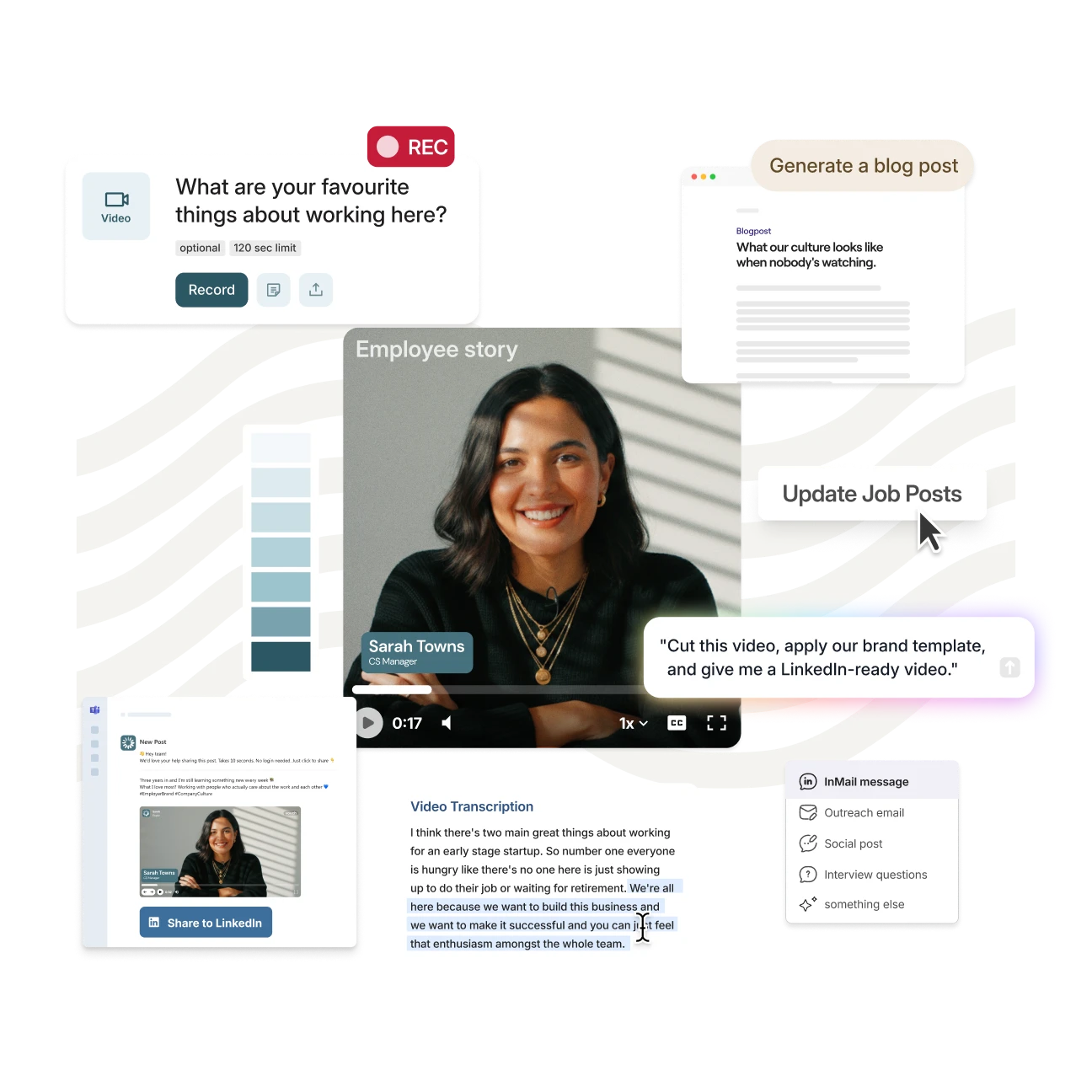
What is an employer brand content request?
An employer brand content request is a structured brief used to collect stories, insights and supporting information from employees and internal stakeholders.
It can be used for:
- Employee videos
- Written testimonials
- Careers page content
- Social posts
- Employee advocacy campaigns
- Job advertisements
- Recruitment emails
- Candidate nurture content
- Internal communications
A good request answers a few basic questions upfront:
- Why is this content being created?
- Who is it for?
- What does the employee need to contribute?
- How long will it take?
- Where will the content be used?
- Who needs to approve it?
- What happens after submission?
The goal is not to script the employee or control every word. It is to make the next step obvious.
That matters when a small employer brand team is collecting employee-generated content across roles, regions or campaigns. Without a consistent process, every request becomes another mini-project and the team repeats the same coordination work.
Why vague content requests create more work
A typical request might sound like this: “Could you record a quick video about the culture?”
It seems simple, but it leaves the employee with several unanswered questions.
- What should they talk about?
- How long should the video be?
- Who will see it?
- Do they need to prepare?
- Will they get to review it?
- What does “culture” actually mean in this context?
The employee puts it aside until they have more time. The employer brand manager follows up. The employee checks with their manager. The manager asks for more context. Communications wants to review the wording. Legal joins after the recording has already been submitted.
The content itself was never the hardest part.
The hidden work around participation, stakeholder coordination, reviews, approvals and follow-up is the real burden. At Vouch, we call this the Coordination Tax: the work required to turn an employee story into content people can actually use.
A strong request reduces that tax by answering the predictable questions before they become another meeting, message or reminder.
Employer brand content request template
Use this as a starting point for video, written content, audio, photos or employee advocacy. You will not need every field for every request. The aim is clarity, not a longer form.
What should you ask employees?
The strongest employee stories come from questions that are specific, grounded in experience and easy to answer. Broad questions usually produce broad answers.
Ask someone “What is the culture like?” and you may get: “Everyone is really supportive.”
It may be true, but it gives candidates very little evidence.
A stronger prompt asks the employee to recall a moment: “Can you describe a time when your team supported you during a difficult project?”
Now the employee has a real moment to draw from. That is more useful for the employee and more credible for the candidate.
Questions about your role
Use these prompts for job-specific or recruiter enablement content:
- What does a typical week in your role involve?
- What types of projects are you currently working on?
- What skills have you developed since joining?
- What surprised you most about the role?
- What is the most rewarding part of your work?
- What is one challenge someone should be prepared for?
- How does your work contribute to the wider organisation?
Questions about the team
Use these prompts to help candidates understand how people work together:
- How would you describe the way your team collaborates?
- What does good support from your manager look like?
- How does your team share ideas or feedback?
- Can you describe a recent team achievement?
- How do remote or distributed team members stay connected?
- What makes the team different from others you have worked in?
Questions about development and progression
Use these when career development is an important part of the employer value proposition:
- What have you learned since joining?
- What opportunities have you had to develop new skills?
- How has your manager supported your career goals?
- Have you moved into a new role or taken on new responsibilities?
- What learning opportunities have been most valuable?
- What advice would you give someone who wants to grow their career here?
Questions about culture and belonging
Avoid asking employees to repeat company values word for word. Ask how those values show up in practice.
- When have you felt most included or supported at work?
- What is one company value you see reflected in everyday decisions?
- How are different perspectives encouraged within your team?
- What does flexibility look like in practice?
- What is something the company does that improves your experience?
- What would you tell someone who is unsure whether they would belong here?
Questions for specific hiring campaigns
For a role, location or talent segment campaign, make the prompts relevant to the candidate’s likely questions. For example:
- What should someone know before joining the Sydney engineering team?
- What is different about working in this regional location?
- What support is available to new graduates?
- How does the organisation support employees returning to work?
- What would an experienced candidate find different about working here?
- What should candidates know about the interview or onboarding process?
Vouch’s guide to employee advocacy content includes more ideas for turning employee stories into role insights, culture content, hiring campaigns and leadership perspectives.
What should you ask internal stakeholders?
Employees are only one part of the request. Employer brand teams also need input from recruiters, hiring managers, communications, legal and business leaders. For a lean team, the important move is to collect that input once, early, rather than manage a chain of late feedback after the employee has recorded.
Internal Stakeholder Brief Template
Privacy requirements vary by country and organisation, so this template is not a substitute for legal advice. The US Federal Trade Commission provides further guidance on collecting, retaining and protecting personal information, including employee data.
How much direction should you give employees?
There is a balance between useful direction and over-scripting. Too little direction creates vague or unusable content. Too much creates corporate copy delivered in an employee’s voice.
Guide the subject, length and purpose. Leave the employee free to explain their experience in their own words.
Prompt Structure
That is enough direction to make the response useful without telling the employee what to think or say.
How to increase employee participation
A strong template removes uncertainty. The way you deliver it determines whether people actually respond.
Choose the right employee
Do not send the request to the largest possible group and hope for the best. Choose employees whose experience matches the objective. Tell them why you selected them and why their perspective matters.
Keep the request focused
One request should usually have one clear objective. Asking an employee to cover culture, leadership, benefits, career development, diversity, their daily work and a current vacancy is not a quick request.
Create separate requests or choose the two or three questions that matter most.
State the time commitment
“Record a quick video” means different things to different people. Say whether the process should take five minutes, ten minutes or half an hour, and keep the estimate honest.
Provide examples without giving them a script
A sample response can help the employee understand the level of detail required. Make it clear that the example is there for guidance and should not be copied.
Make recording simple
Every extra step gives a busy employee another reason to come back later. Vouch lets teams send a browser-based request link so employees can record from their own device, without installing an app or coordinating a production session. The team can then edit, caption, brand and organise the content in the same workflow.
For more advice on organising and reusing submissions, read How to Build an Employee Content Library That Actually Gets Used.
Schedule reminders in advance
Do not wait until the deadline has passed to follow up. A simple reminder sequence may include:
- Initial request
- Reminder halfway to the deadline
- Final reminder 24 to 48 hours before the deadline
- Thank-you and next steps after submission
Make the reminder useful, not guilt-driven. Repeat why the employee was selected, how long it should take and where to submit. Vouch requests include automatic reminders to employees.
Close the loop
Tell the employee when the content is live and show them where it appears. Participation gets easier when people can see that previous stories were valued and put to good use.
How to manage content requests at scale
A spreadsheet and email thread may work for one campaign. They become another coordination job when requests are running across multiple roles, countries, recruiters and business units.
At scale, employer brand teams need visibility across:
- Active requests
- Participants
- Submission status
- Deadlines
- Consent and usage information
- Stakeholder approvals
- Editing status
- Final assets
- Distribution channels
- Expiry or refresh dates
This is where a repeatable content system becomes more useful than a series of disconnected campaigns.
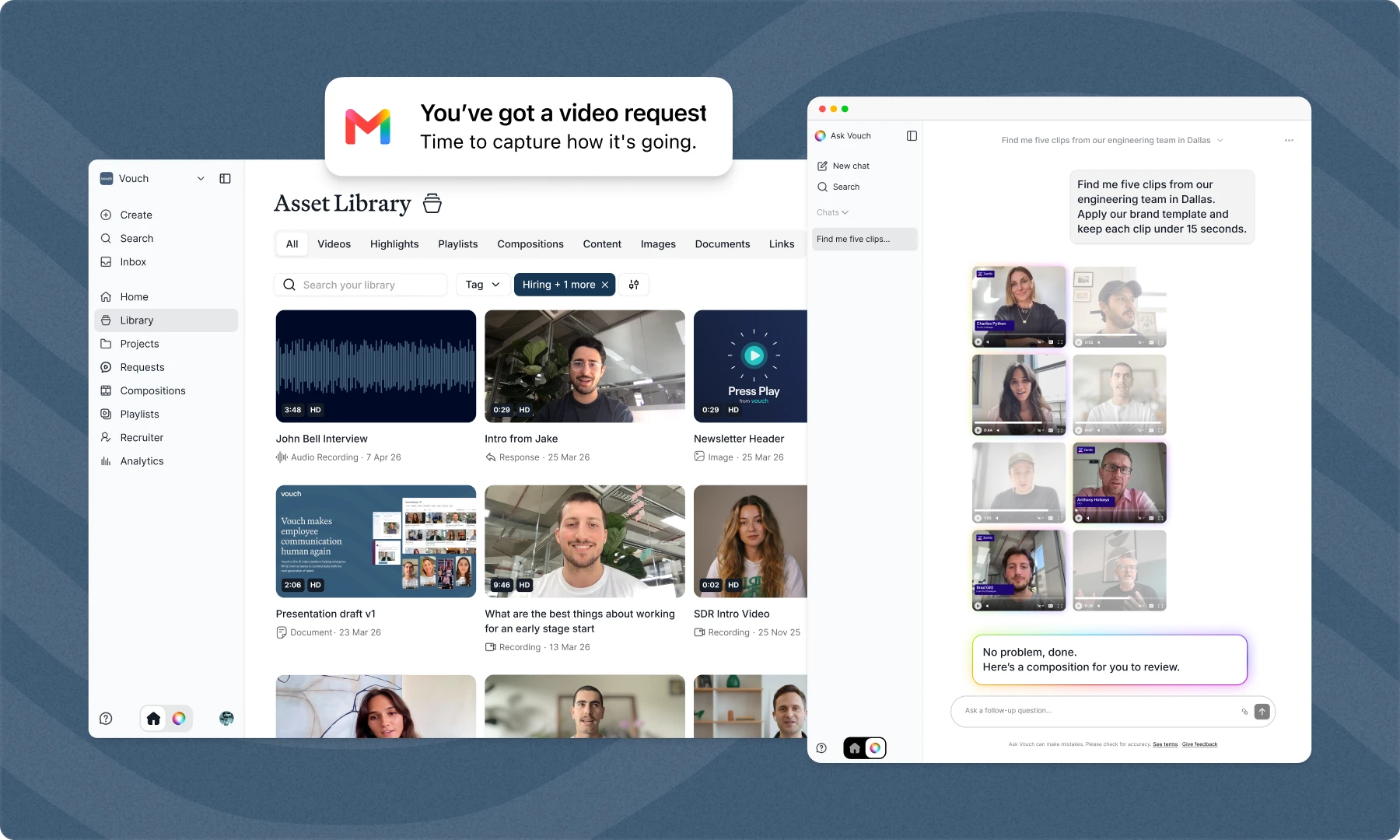
Vouch helps employer brand teams collect employee stories, manage content centrally, find relevant clips and repurpose approved content across recruitment and advocacy channels.
Instead of recreating the coordination process for every request, teams can build a searchable content library that becomes more useful over time.
The goal is not simply to collect more content. It is to make the route from internal request to approved, usable asset shorter and easier to repeat.
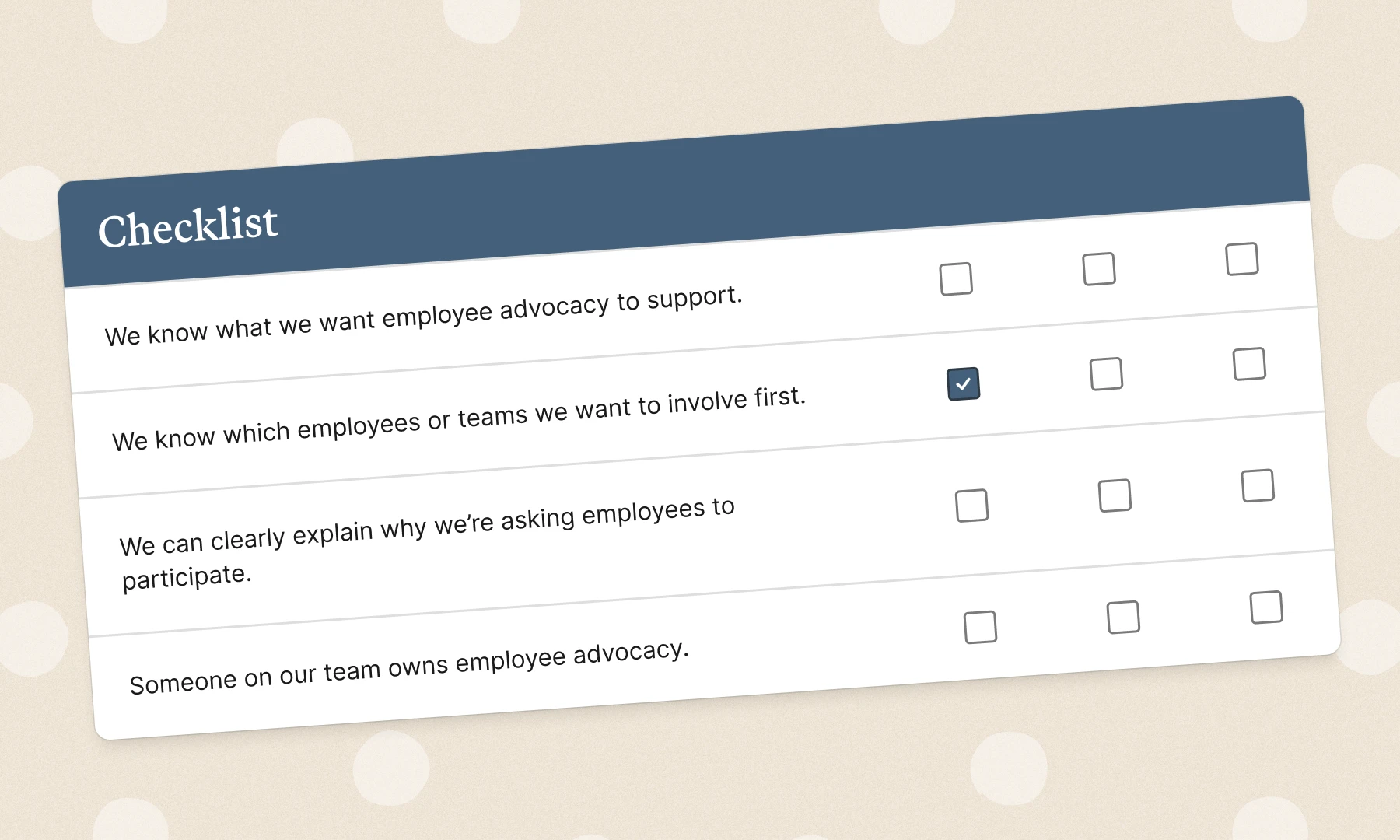
Employer brand content request checklist
If any of these details are unclear internally, resolve them before involving the employee.
Turn content requests into a repeatable system
Lean employer brand teams cannot afford for every content request to become a new project. The strongest programs do not depend on one enthusiastic employee, one annual video shoot or an employer brand manager manually coordinating every submission.
They build a repeatable process. A clear request tells employees why their perspective matters and makes participation easy. A structured stakeholder brief prevents late feedback. A central content system makes every approved story easier to find, reuse and distribute.
Vouch gives employer brand teams one place to request authentic employee content, edit and organise submissions and turn them into usable assets for careers sites, recruitment campaigns and employee advocacy.
Less chasing. Fewer handoffs. More employee stories making it into the market.
Ready to reduce the Coordination Tax around employee content? Book a demo and see how Vouch works.
Frequently Asked Questions
What should an employer brand content request include?
An employer brand content request should include the objective, target audience, reason the employee was selected, requested format, questions, time commitment, deadline, usage channels, editing process, approval requirements and submission link. The employee should be able to understand what is required without needing a meeting or a separate email exchange.
How many questions should you ask an employee?
For a short employee video, two to five focused questions are usually enough. Asking too many questions can make the request feel time-consuming and produce a response that lacks focus. Choose the questions that are most closely connected to the campaign objective and candidate audience.
Should employees be given a script?
Employees can be given talking points, prompts and examples, but a complete script often makes the result feel less authentic. Ask open-ended questions and encourage employees to include specific experiences. Provide guidance on length, confidentiality and the intended audience without dictating their opinion.
Should employees approve employer brand content before publication?
The appropriate process depends on company policy and applicable legal requirements. Many organisations allow employees to review the edited version before publication, particularly when their image, voice or personal experience is featured. The review process should be explained before the employee records or submits anything.
How can employer brand teams improve employee response rates?
Make the request relevant, specific and easy to complete. Explain why the employee was selected, limit the number of questions, state the time required, provide a direct recording link and schedule reminders before the deadline. Showing employees how their previous contributions were used can also encourage future participation.
How can content requests be managed across a global organisation?
Use a standard request template while allowing regional teams to adapt questions, approvals, language and privacy requirements. A central platform can help employer brand teams track submissions, organise approved assets and maintain visibility across campaigns without managing every request through separate inboxes and spreadsheets.

You might also like

Elevate Your Brand Today With Vouch
Discover how Vouch can accelerate talent acquisition while helping you stay on-brand.